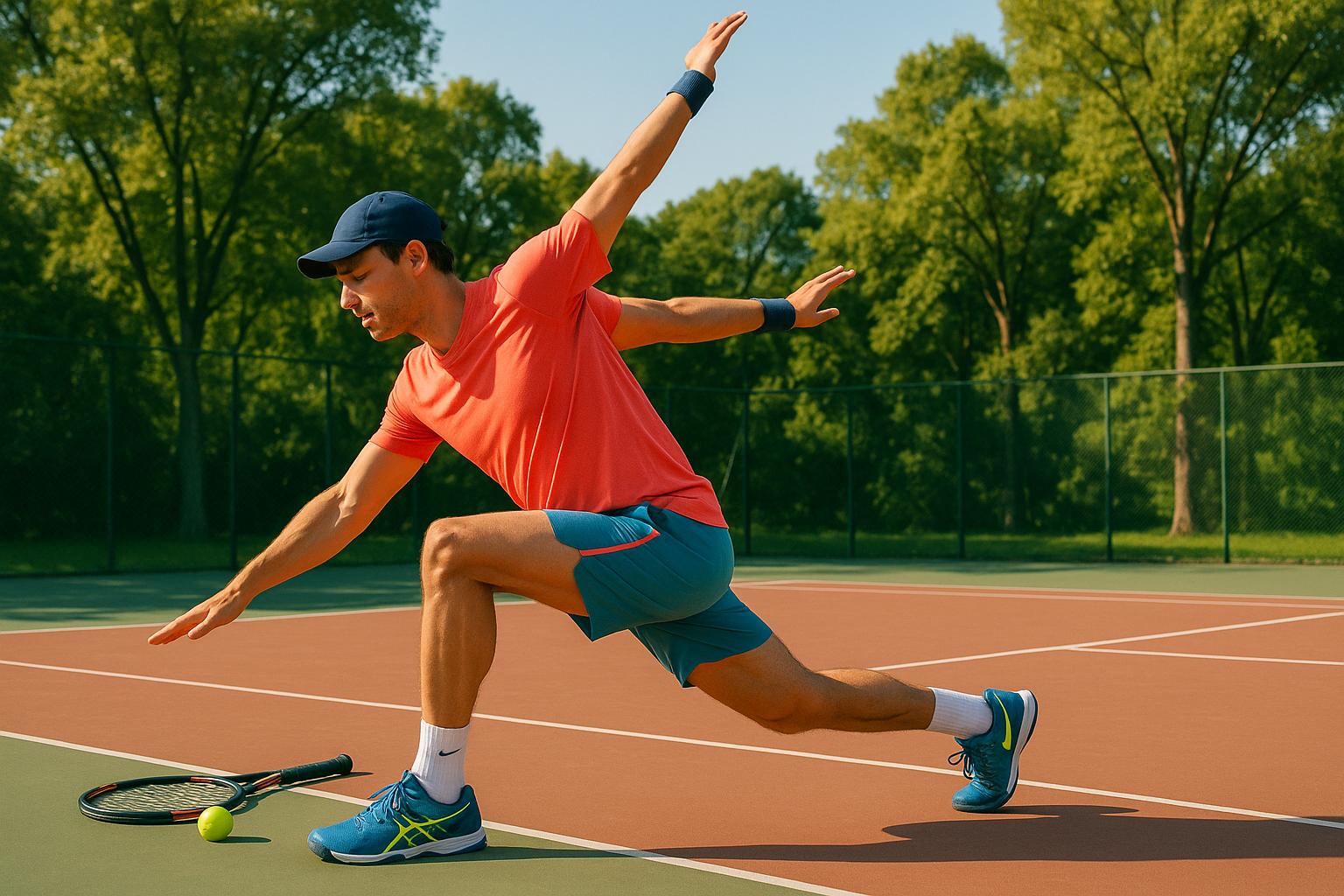
Footwork is the backbone of great padel and tennis performance. Without it, even the best shots won't matter if you can't reach the ball. The drills below focus on improving your agility, balance, and speed to make you more efficient and confident during rallies. Here's a quick breakdown:
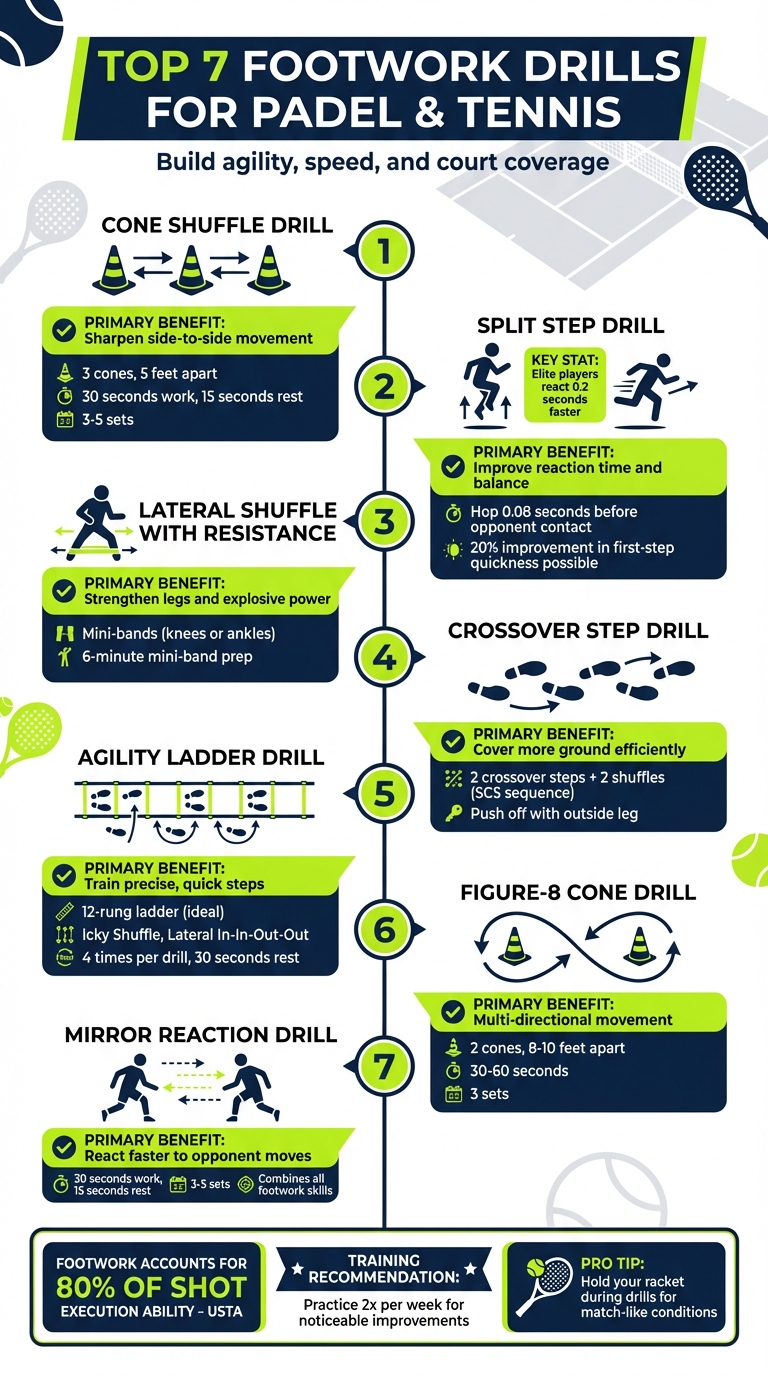
- Cone Shuffle Drill: Sharpen side-to-side movement.
- Split Step Drill: Improve reaction time and balance.
- Lateral Shuffle with Resistance: Strengthen legs with mini-bands.
- Crossover Step Drill: Cover more ground efficiently.
- Agility Ladder Drill: Train precise, quick steps.
- Figure-8 Cone Drill: Practice multi-directional movement.
- Mirror Reaction Drill: React faster to your opponent's moves.
These drills are practical, easy to set up, and can be done with minimal equipment. Practice them twice a week, and you'll see noticeable improvements in your court movement. Ready to level up your game? Let’s dive in.
7 Essential Footwork Drills for Padel and Tennis Players
5 Footwork Movements (and Exercises) to Instantly Transform Your Padel Game (Move Your Feet Right!)
sbb-itb-5591e69
1. Cone Shuffle Drill
The Cone Shuffle Drill is designed to sharpen quick side-to-side movements, a key skill in padel and tennis. To set it up, place three cones in a straight line, about 5 feet apart (approximately 1.5 meters). Start at the middle cone in a ready position - feet shoulder-width apart, knees bent, and weight evenly distributed. Shuffle to one side cone, touch it, then return through the middle to the other cone. Repeat this pattern for 30 seconds, rest for 15 seconds, and aim for 3 to 5 sets [7].
This simple yet effective drill helps improve lateral movement, balance, and agility.
Improves Lateral Movement
To get the most out of this drill, focus on driving off your outside leg to generate strong directional force. Use larger strides when pushing off, similar to the recovery steps after a wide defensive shot. As you approach each cone, switch to smaller adjustment steps for better control [3].
Enhances Balance and Stability
Maintaining a low stance is critical for stability during quick directional changes. As noted by Mantis Sport's editor:
"Your centre of gravity must remain low throughout the entire drill. Bend your knees and hips to absorb the impact of landing and to create a powerful base to explode from for the next movement" [3].
Touching each cone helps reinforce this low center of gravity, which is crucial for maintaining balance during fast-paced gameplay.
Builds Speed and Agility
This drill also trains explosive first-step quickness, a vital skill for transitioning from defense to offense [3]. Staying on the balls of your feet keeps you light and ready for rapid direction changes. Advanced players can push themselves with 60-second bursts, while beginners should stick to 30-second intervals with 15 seconds of rest. To make the drill more game-like, hold your racquet while performing the movements, simulating real match conditions.
2. Split Step Drill
The Split Step Drill is a game-changer for improving reaction time in padel and tennis. Building on the lateral agility developed in the Cone Shuffle, this drill focuses on syncing a small, timed hop with your opponent's shot. Here’s how it works: stand with your feet shoulder-width apart, stay on the balls of your feet, and keep your knees slightly bent. The key is to initiate the hop about 0.08 seconds before your opponent makes contact with the ball[8]. If timing feels tricky, try saying "hop" out loud at the moment of contact to help synchronize your movement[8]. This precise action lays the groundwork for quicker lateral movements, better balance, and explosive speed.
Improves Lateral Movement
The split step acts like a spring, pre-loading your calf and thigh muscles to store energy for rapid side-to-side movement. When you land, these muscles compress and release energy for a powerful push. To move left, push off your right foot; to move right, push off your left foot[10]. This technique can enhance court coverage by up to 12% for players with well-timed footwork[11].
Enhances Balance and Stability
A proper split step is essential for maintaining balance and staying ready for the next move. According to the USTA, solid footwork accounts for 80% of a player's ability to execute a shot[11]. Landing with a wider stance and keeping a low center of gravity creates a stable base, allowing for quick directional changes. Tennis legend Roger Federer once said:
"Footwork is everything. It's what gets you to the ball in time to hit your best shot"[10].
Without a stable foundation, you risk overreaching or losing proper positioning, which can throw off your game.
Builds Speed and Agility
To maximize speed, keep your split step low and controlled - high jumps waste energy and slow you down[9]. Land softly on the balls of your feet with bent knees, ready to explode in any direction. A helpful practice sequence is the Split–Crossover–Shuffle (SCS): perform a split step, follow with a two-step crossover, and finish with two shuffles[2]. This sequence, practiced without a ball, helps lock in muscle memory. Fun fact: elite players ranked in the top 10 ATP rankings react 0.2 seconds faster than those ranked in the top 100, and focused training can improve first-step quickness by 20% in just a few weeks[11]. Mastering this drill not only refines your reaction time but also prepares you for more advanced agility exercises.
3. Lateral Shuffle with Resistance
Building on the split step drill, lateral shuffles with resistance add an extra layer of intensity by using mini-bands to boost power and control during court movements [1][2]. Placing mini-bands around your knees or ankles activates the hip abductors and glutes - key muscles for the explosive "drop-and-drive" motion. This drill focuses on strengthening the outside leg, which plays a critical role in pushing back toward the center of the court [1][2]. By adding resistance, this exercise sharpens both strength and precision.
Improves Lateral Movement
The added tension from the mini-band forces your outside leg to work harder, improving your ability to change direction swiftly. To maximize efficiency and prevent overreaching, keep your nose, knees, and toes aligned over your midfoot. As LTA Expert Coach Matt Smith puts it:
"Movement is the core of tennis and the way we coach is often in the order of feet, body, racket – so we build it from the ground up" [1].
A quick 6-minute mini-band warm-up can prepare your body for these sharp, dynamic movements [2].
Enhances Balance and Stability
The resistance from the mini-band encourages you to maintain a low, athletic stance, keeping your feet shoulder-width apart and your weight balanced on the balls of your feet [4][2]. This stable posture is essential for executing shots with confidence. By focusing on loading your outside leg before changing direction, you practice controlled deceleration - a vital skill for maintaining balance on both hard and clay courts [2]. Additionally, the drill reinforces proper visual focus by encouraging you to keep your head facing the net [2].
Builds Speed and Agility
Speed stems from efficiency. Resistance shuffles teach you to combine powerful, longer steps with smaller, precise adjustment steps to fine-tune your position before each shot. A great example is the Split–Crossover–Shuffle (SCS) sequence: take a strong crossover step to close the gap quickly, then use shuffles to refine your positioning [1][2]. Pay attention to your shin angles and avoid overreaching with your knees. While hard courts require quicker stops and greater ankle stiffness, clay courts allow for smoother, more controlled slides during lateral movement [2].
4. Crossover Step Drill
The crossover step is a key movement that helps players cover the court more efficiently. Once you've mastered these drills, you can book a padel court at various UK locations to test your skills. It involves stepping one foot behind the other to pivot and change direction with speed and agility. While shuffling works for small adjustments, the crossover step is ideal for covering greater distances quickly. LTA Expert Coach Matt Smith highlights its importance:
"Generally, running is the quickest movement to the ball, including a combination of run, cross-over and sidesteps to help you get there and recover" [1].
Enhances Lateral Movement
The crossover step is a game-changer for improving lateral mobility. It allows you to cover more ground across the court compared to basic shuffling. For wide shots, it acts as a powerful first move, helping you reach the ball faster. To execute it effectively, push off forcefully with your outside leg to generate speed and return to the center quickly. Incorporating this into the SCS sequence - using two crossover steps followed by two shuffles - helps you master transitions between long strides and smaller, controlled adjustments. This combination not only sharpens lateral speed but also ensures you're balanced and ready for your next shot, mimicking match conditions.
Prepares for Match-Specific Movements
The crossover step mirrors the kind of movements you'll use during a match. It’s especially useful for chasing deep cross-court shots or executing quick lateral moves in doubles, like poaching at the net. UTR Sports underscores its value:
"Your first step is your fastest step. Use a drop step or a pivot-crossover when moving wide" [2].
To refine this skill, practice shadow swings at the court's corners, focusing on smooth crossover recoveries. Keep your head steady and maintain a low posture with your hips for balance and readiness. This drill not only sharpens your footwork but also builds confidence for real-game scenarios.
5. Agility Ladder Drill
The agility ladder is a fantastic tool for improving quick, balanced footwork, helping players cover the court more effectively. Unlike drills that focus on isolated movements, this one pushes your brain and body to sync up for more complex sequences, making it easier to pick up other skills along the way [12].
Builds Speed and Agility
After working on short, explosive movements with earlier drills, the agility ladder takes things up a notch by training more intricate patterns. These drills condition your neuromuscular system to handle faster directional changes on the court [3]. Patterns like the "Icky Shuffle" (an in-in-out motion) and "Lateral In-In-Out-Out" mimic the shuffle steps you’ll use along the baseline [3][12]. They fine-tune your ability to make quick, precise adjustments - key for setting up a forehand or reacting to a drop shot in real time [3].
The Mantis Editor at Mantis Sport highlights the importance of proper technique:
"Always stay on the balls of your feet. This engages your calf muscles and ensures you remain light and springy, ready to change direction instantly, just as you would during a point." [3]
Start slow to master the pattern, then gradually pick up the pace. Once you’re comfortable, lift your head to focus forward instead of down at your feet. Keep a slight forward lean, bend your knees, and use active arms to maintain balance [3][12]. For added realism, perform these drills while holding a racket [3][5].
Simulates Real-Game Scenarios
Beyond just improving speed, ladder drills enhance your match-specific footwork. They teach you to switch seamlessly between "big steps" for closing distance and "small adjustment steps" to stabilize before hitting the ball [1][5]. This mirrors the kind of movement you need to chase down wide shots and position yourself for clean contact. Jon Crim, Founder of TennisCompanion, explains the broader benefits:
"By improving your footwork, you enhance your ability to execute your game to the best of your ability, which can improve your confidence and help you maximize your performance." [12]
A 12-rung ladder is often considered ideal - it’s long enough to be challenging but still easy to transport [12]. To ensure balanced training, always repeat drills starting with the opposite foot, working both sides equally [12]. Beginners should aim to complete each drill four times with 30 seconds of rest in between, while advanced players can push through circuits with minimal rest [5][12].
6. Figure-8 Cone Drill
The Figure-8 Cone Drill is a fantastic way to fine-tune your lateral agility, balance, and multi-directional movement. By weaving through a figure-8 pattern around two cones, you simulate the constant shifts and quick adjustments required during a match. This drill not only hones your footwork but also sharpens the timing and technique of your forehand and backhand strokes.
Improves Lateral Movement
This drill requires you to shuffle between cones, helping you develop the quick footwork needed to recover between shots. The sharp turns and frequent direction changes mimic the demands of wide-ball recovery during a match. Pay close attention to your adjustments around each cone, as this will enhance your ability to return to a stable base quickly and efficiently.
Enhances Balance and Stability
Set up two cones 8–10 feet apart at the mid-baseline. Start at the center mark, shuffle around one cone, move diagonally through the center to the other cone, and circle it to complete the figure-8. Stay low in your stance to maintain balance during sharp turns. UTR Sports highlights the importance of form:
"Shuffle around cone A, crossover to cone B, shuffle around cone B, and repeat, tracing a figure-8 path. Focus: Low hips, eyes forward, crisp foot contacts." [2]
Keep your eyes forward and head facing the net throughout the drill to maintain court awareness. For an added challenge, incorporate shadow strokes like forehands and backhands at specific points. You can also have a partner feed live balls just outside the cones to simulate real match conditions.
Simulates Real-Game Scenarios
The figure-8 pattern trains you to move forward, backward, and laterally in a fluid and continuous motion, closely mirroring the dynamic movements of a match. Alternate between larger closing steps and smaller adjustments as you navigate the cones. Start with 3 sets of 30 to 60 seconds, prioritizing precise movements over speed. As your skills improve, increase the intensity by timing your sets or introducing live ball feeds to push your explosiveness and adaptability on the court. Once you've mastered these drills, you can find nearby clubs to test your improved agility in a match.
7. Mirror Reaction Drill
The Mirror Reaction Drill is all about sharpening reaction time and honing your ability to read an opponent’s movements. Unlike stationary exercises, this drill keeps you on your toes, forcing you to respond to unpredictable cues from a partner or coach. It’s designed to simulate the randomness of a live rally, helping you build explosive lateral movement and quick decision-making - two essentials for competitive play. Plus, it brings together all the footwork fundamentals you’ve already practiced, creating a dynamic, match-like scenario [4][14].
Improves Lateral Movement
This drill is great for fine-tuning your ability to handle sudden directional changes [4]. Your partner leads the exercise, moving side-to-side or feeding balls to different areas of the court, while you mirror their movements as quickly as possible. The key is to use your outside leg to drive those sharp, precise adjustments, which not only speeds up your recovery but also helps you return to the center of the court efficiently [4][1]. One thing to avoid? Crossing your legs during lateral shuffles - it throws off your balance and leaves you exposed to the next shot [13].
Builds Speed and Agility
Start in a hip-width stance, keeping your weight on your toes with knees slightly bent [4][2][3]. As your partner moves or calls out directions, perform a split step - a small hop landing on both feet - right before initiating movement to react faster [13]. Matt Smith, an LTA Expert Coach, explains the importance of building movement from the ground up:
"Movement is the core of tennis and the way we coach is often in the order of feet, body, racket – so we build it from the ground up" [1].
Aim for 30-second intervals with 15 seconds of rest, repeating for 3–5 sets. This not only boosts your reaction time but also builds endurance specific to the demands of the sport [7].
Simulates Real-Game Scenarios
The Mirror Reaction Drill combines all the footwork skills you’ve learned - split steps, lateral shuffles, and small adjustment steps - into one exercise that mirrors the intensity of a real match [4][13][15]. Use large, explosive steps to cover distance, then switch to smaller, controlled steps as you approach the ball to stay balanced [1]. Keep your head facing the net throughout the drill, just like you would during an actual rally, to maintain court awareness [1]. Another critical component is the "push back" movement, which ensures you return to a neutral position after every shot, ready to cover the court during fast-paced exchanges [14][1]. This drill ties together all the key movements - split steps, shuffles, and crossovers - making it an essential tool for mastering court coverage in competitive play.
Conclusion
As Matt Smith, an LTA expert coach, points out, footwork is the key to reaching the ball on time and executing shots effectively[1]. The seven drills outlined here focus on essential elements of court movement - like lateral agility, explosive speed, balance, and reaction time. Together, they help players deliver precise shots, recover quickly, and maintain control during even the most demanding rallies. These skills are the backbone of both offensive and defensive play, reinforcing the movement patterns needed to compete at a high level.
Footwork training isn’t just about speed. Regular practice also lowers the risk of injuries by improving deceleration techniques and reducing strain on joints and muscles[2]. Plus, arriving at the ball in time gives players the chance to prepare properly, leading to more consistent and powerful shots. With a dedicated speed and agility program, players can see noticeable improvements in their movement on the court in just a few weeks[6].
For best results, practice these drills twice a week. Incorporating your racket into ladder and cone drills can make the exercises feel more like actual match play, helping you adapt to the weight and balance of your equipment[5].
If you’re looking for top-notch facilities to take your training further, check out Padel and Tennis Courts in the UK. The site offers a directory of courts across London, Surrey, and beyond, making it easier to find venues, training programs, and tournaments. Whether you’re just starting out or fine-tuning your game, improving your footwork will elevate both your performance and confidence on the court.
FAQs
How long should each drill session take?
Each drill session should be around 4 minutes long. This timeframe strikes the perfect balance, giving you enough focused practice to refine your footwork while keeping the intensity high. These short, targeted sessions are excellent for boosting your lateral movement, balance, and overall speed.
Which drill helps most with faster reaction time?
The Reaction Ball Drill is a great way to work on your reaction time. By using reaction balls or other lightweight tools, this drill helps improve your visual reflexes and quick decision-making. It's especially useful for boosting your ability to respond rapidly during Padel or Tennis matches.
Do I need any equipment for these drills?
You’ll need a racket, tennis balls, and a suitable wall or open space for practicing rebound drills. If you want to mix things up, optional tools like cones or markers can add variety, but they’re not a must. The key is to make the most of what you already have for productive practice sessions.