Padel is booming worldwide, with over 35 million players across 150+ countries as of 2025. The sport has evolved from a niche activity in Spain and Argentina to a global phenomenon, driven by growing participation, expanding infrastructure and court hire options, and increasing professional tournaments.
Key highlights:
- Player Growth: 35M active players, 11,000+ ranked professionals, and a significant rise in female and junior participation.
- Infrastructure: Over 77,300 courts and 24,600 clubs globally by 2025, with the U.S. seeing a 34x increase in courts since 2019.
- Tournaments: FIP events grew 59% from 2024 to 2025, with 290 tournaments globally. The U.S. alone will host 255 events in 2026.
- Economic Impact: Prize pools now exceed €1 million in major events, attracting luxury sponsors and turning tournaments into lucrative ventures.
- Regional Expansion: Europe leads with 61% of players, while the U.S., Middle East, and Africa are emerging markets.
While challenges like infrastructure costs and geopolitical issues exist, padel's rapid growth shows no signs of slowing. The sport's market value is projected to hit €6 billion by the end of 2026, with increasing global traction and institutional recognition, including efforts to join the Olympics.
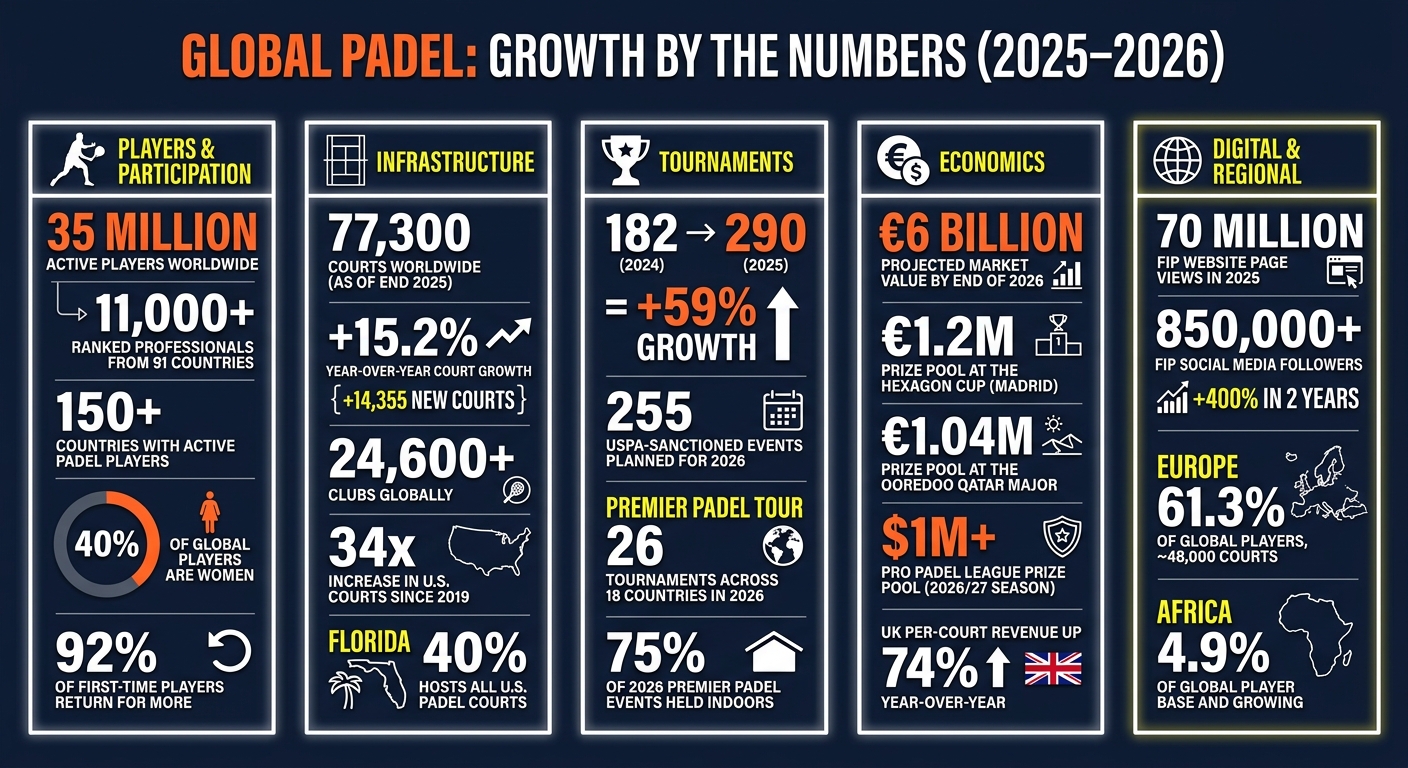
Global Padel Growth by the Numbers (2025–2026)
Global Padel Tournament Growth: Key Trends
Player Numbers and Demographics
Padel is making waves globally, with an impressive 35 million amateur players fueling its growth, alongside over 11,000 ranked professionals from 91 countries actively competing [3]. A standout trend is the increase in female participation - women now make up around 40% of the global player base [9]. Another exciting development is the rise in junior participation, driven by accessible programs and the sport's easier learning curve compared to tennis. Remarkably, 92% of first-time players return for more, ensuring a steady influx of new enthusiasts. This growing interest has directly contributed to a surge in courts, clubs, and tournament opportunities worldwide.
Court, Club, and Tournament Expansion
The sport's infrastructure has been expanding at an incredible pace. FIP events saw a 59% jump in just one year, growing from 182 tournaments in 2024 to 290 in 2025 [6]. By the end of 2025, the number of padel courts worldwide hit 77,300, marking a 15.2% year-over-year increase with 14,355 new courts added [3][7]. Similarly, the number of clubs has surpassed 24,600 globally [2][3]. On the professional circuit, the Premier Padel tour has grown to 26 tournaments across 18 countries for the 2026 season [6][8].
The U.S. market mirrors this growth. Similarly, players can find top UK padel locations as the sport expands across Europe. The USPA more than doubled its sanctioned open tournaments, jumping from 48 in 2024 to 104 in 2025, with 255 events already on the books for 2026 [6]. Notably, nearly 75% of the 2026 Premier Padel tour events are held indoors, a setup that ensures year-round play and appeals to sponsors and broadcasters alike. As tournaments multiply, the sport's financial ecosystem has seen a dramatic transformation.
Prize Money, Sponsorship, and Economic Impact
The financial stakes in padel have reached new heights. The Hexagon Cup in Madrid boasts a €1.2 million prize pool, while the Ooredoo Qatar Major offers €1.04 million [6]. In North America, the Pro Padel League has set its 2026/27 season prize pool at over $1 million [6]. This surge in prize money reflects padel's rise as a serious professional sport. Luxury brands are also taking notice, drawn by the sport's affluent and socially active audience. Merrick Haydon, Founder of ThirtyThree18, explains:
"Padel gives luxury brands access not just to wealth, but to a very particular kind of wealthy consumer: socially active, image-conscious, and highly networked." [11]
Tournaments are also becoming major revenue drivers for clubs. According to a spokesperson from MejorSet:
"Today, well-structured padel tournaments can generate six to seven figures annually across entry fees, sponsorship and brand activations, increased court occupancy, food and beverage uplift and media exposure." [6]
A prime example of this trend occurred in 2025 and early 2026, when Cesc Caceres, CEO of Padel Smash Academy, organized corporate mixers for financial giants BlackRock and Citadel, leveraging their corporate event budgets [6]. These events are increasingly seen as networking opportunities, much like golf. With the sport's market value projected to reach €6 billion by 2026, padel's financial momentum shows no signs of slowing down [10].
sbb-itb-5591e69
Regional Expansion of Padel Tournaments
Europe: The Center of Padel Tournaments
Europe continues to dominate the padel scene, home to about 61.3% of the world's players and nearly 48,000 courts [5]. Spain leads the charge with close to 17,000 courts, followed by Italy with 9,700 courts. Globally, Argentina, though outside Europe, stands as a key benchmark with approximately 7,000 courts [5]. In contrast, markets like Sweden and Finland, which experienced rapid post-COVID growth, are now stabilizing as supply meets demand [3]. This shift highlights a maturing phase in these countries, with investments now pivoting toward regions with untapped potential.
Growing Markets: Latin America, the Middle East, and Beyond
Latin America has long been a padel powerhouse, with Argentina and Mexico at the forefront. The growth doesn't stop there - countries like Chile and Paraguay are projected to exceed 2,000 courts by 2025 [5]. Meanwhile, the Middle East is making waves with substantial investments, particularly from Qatar and Saudi Arabia. The Ooredoo Qatar Major, boasting a prize pool of €1.04 million, showcases the region's ambitions. According to Jon Dault, Partner at Fletchstone Global:
"We will see Dubai take over the largest tournaments, and draw the largest number of people." [6]
Africa is also stepping into the spotlight. In 2026, Padel 4 Maroc in Casablanca joined the Cupra FIP Tour, featuring 10 FIP-approved courts designed for international competitions. This marks a significant milestone for Africa, which currently represents about 4.9% of the global player base [3]. These developments set the stage for emerging markets like the United States and the United Kingdom, signaling even broader global growth.
Early-Stage Growth in the UK and North America
The United States and United Kingdom are quickly catching the padel wave. In the U.S., the number of courts has grown 34-fold since 2019 [9]. Florida dominates the scene, hosting 40% of all U.S. padel courts, with Miami emerging as a hub. The Miami Premier Padel tournament in March 2026 drew 5,000 fans during its final stages [13]. Renowned player Fernando Belasteguin sees immense potential in the region:
"The United States is a new market, but the only thing padel needs is time. Wherever the sport takes root, it thrives." [13]
The UK is also gaining momentum. Now ranked among the top three global markets by revenue, the country has seen per-court revenue rise 74% year-over-year [12]. The Lawn Tennis Association (LTA) is playing a key role, hosting FIP-sanctioned tournaments with prize pools reaching €150,000. Grassroots efforts, like the LTA's Grade 5 Local Tour, are further driving growth. For those in the UK looking for courts, training, or tournament details, Padel and Tennis Courts in the UK is a helpful resource.
Challenges and Opportunities in Tournament Growth
Barriers to Growth
Padel's rapid rise hasn't come without obstacles. One of the biggest hurdles is infrastructure. In the U.S., there’s only about one court for every 1,529 core players - putting nearly 3.1 times the strain on facilities compared to tennis [14]. As of March 2026, 27 states in the U.S. still lacked padel venues entirely [14]. Building premium indoor courts is no small feat either, with costs ranging between $150,000 and $250,000. To meet FIP standards, facilities also require pricey, specialized materials [6][14].
Geopolitical instability has thrown an additional wrench into the mix. For instance, in April 2026, the Ooredoo Qatar Major - boasting a €1.04 million prize pool - was postponed indefinitely due to conflict in the Gulf region [6]. To counteract the disruption, Premier Padel elevated the Pretoria P2 to a P1 and upgraded the Kuwait P1 to a Major, ensuring players still had access to ranking points and prize money [15].
"These tournament upgrades prioritize player interests, ensuring more ranking points and prize money is available, whilst minimising the disruption of geopolitical events on the Tour." - David Sugden, CEO of Premier Padel [15]
Urban markets also present their own challenges. Strict zoning regulations often delay the development of new facilities, creating additional roadblocks for growth [14]. However, these very challenges are pushing the sport to adopt more innovative and flexible approaches to expand its reach.
Opportunities for Further Expansion
While the barriers are real, the opportunities for growth are just as compelling. Corporate sponsorship has emerged as a key revenue stream. Companies like BlackRock and Citadel have started using padel clubs for team-building events, often paying extra for coaching and organized tournaments [6].
"For clubs and investors, tournaments are no longer just visibility, they're a revenue engine and part of their growth strategy." - MejorSet Spokesperson [6]
Clubs are also reimagining tournaments as full-fledged experiences. By incorporating elements like music, catering, and social gatherings, they are transforming competitions into something more engaging. Alessandro Corti, CEO of Padel Consulting, highlights this shift:
"The key to monetising tournaments is to turn them into 'experiences', for example with music and Prosecco offerings, rather than just competitions." - Alessandro Corti, CEO of Padel Consulting [6]
On the digital side, the sport is thriving. In 2025, FIP’s website racked up 70 million page views, while its social media following skyrocketed by 400% in just two years, reaching over 850,000 followers [3]. The U.S. has also seen a surge in sanctioned events, with the USPA overseeing 255 tournaments in 2026, a massive leap from just 48 in 2024 [6]. With corporate backing and digital momentum, padel tournaments are well-positioned to continue their global expansion.
Conclusion: Where Global Padel Tournaments Are Headed
Key Takeaways
Padel has transformed from a local pastime into a thriving global sport. In just one year, FIP-organized tournaments surged by 59%, climbing from 182 in 2024 to 290 in 2025. This rapid growth mirrors the sport's rising popularity, with millions of players now active across 150 countries [1][3]. By 2026, the global padel industry is expected to reach €6 billion, while FIP's website recorded an impressive 70 million page views in 2025 [3].
Although Europe remains the sport's stronghold, its expansion beyond the continent is undeniable. The U.S. has seen a remarkable increase in court installations since 2020, and with 255 USPA-sanctioned tournaments scheduled for 2026, North America is emerging as a major player. Meanwhile, the debut of Premier Padel in Pretoria, South Africa, highlights the sport's growing geographic diversity [4].
"Padel has moved beyond being a trend to become a structured industry, with professional stakeholders at every level." - Álex Ponseti, Director of the Padel World Summit [10]
Efforts to include padel in the Olympics underscore its rising institutional recognition. The bid for the 2036 Games has sparked increased government interest, elevating the sport's profile beyond sponsorships and prize money [4][16]. As the sport continues to expand, future research will need to explore challenges like infrastructure demands, sustainability, and economic viability. This includes the logistical challenges of building a padel court to meet international standards.
Directions for Future Research
Padel's rapid ascent raises important questions for its future. Nordic countries like Sweden and Finland have already experienced boom-and-bust cycles, prompting concerns about the long-term stability of fast-growing markets [3]. Research into participation retention rates, rather than just new player sign-ups, could provide a clearer picture of whether the sport's growth is sustainable or fleeting. Additionally, comparing the economic dynamics of padel vs tennis and other racket sports like pickleball, could shed light on its commercial potential.
As Atte "Alejandro" Suominen, CEO of PADEL1969, stated:
"The 35+ million player figure represents only the beginning of padel's global journey. We anticipate the 50 million player milestone within 24 months." [3]
Whether this ambitious projection materializes will have major implications for tournament infrastructure, prize money, and regional development. These are exactly the kinds of questions that future research must tackle to ensure the sport's continued success.
FAQs
How do I start playing in FIP-sanctioned padel tournaments?
To join FIP-sanctioned tournaments, head over to the official International Padel Federation website. FIP provides circuits tailored to different skill levels: the CUPRA FIP Tour for those aiming to go pro, the FIP Promises Tour for young players, and the FIP Beyond Tour for amateurs and seniors. Simply browse the event calendar and register directly through the FIP portal to kick things off.
What’s limiting padel court and tournament growth in the U.S. right now?
Padel’s expansion in the U.S. is hitting a few bumps, particularly when it comes to infrastructure and finances. Building courts isn’t cheap - materials like synthetic turf, sand, glass panels, and custom screens make construction costs steep. On top of that, padel is vying for attention against the surging popularity of pickleball, which has quickly become a favorite for many.
For padel to keep growing, a few things need to happen: increasing access to court time, training more skilled coaches, and focusing on long-term player development beyond just private clubs. These steps will be key to the sport’s future in the U.S.
How do padel tournaments generate revenue beyond entry fees?
Padel tournaments bring in money through several avenues, starting with ticket sales, sponsorship deals, and hospitality services. On top of that, events often boost revenue through onsite retail, catering, and increased sales of food and drinks during the matches.
But the benefits don't stop there. These tournaments often drive long-term membership growth and encourage higher usage of courts. Clubs can also get creative by offering special experiences - think social gatherings, live music, or even travel packages. These extras not only enhance the spectator experience but also provide more opportunities to generate income.