Padel doubles is all about teamwork and smart positioning. Success on the court depends on moving in sync with your partner, controlling the net, and maintaining clear communication. Here’s a quick breakdown of the key strategies:
- Invisible Rope Concept: Always move as a unit with your partner to cover gaps and stay balanced.
- Offensive Tips: Control the net by standing 6–10 feet from it. Avoid "No Man's Land" and advance together after a strong shot.
- Defensive Tips: Position about 6 feet behind the service line to handle fast shots and rebounds. Move together to avoid leaving openings.
- Roles: The left side suits aggressive players, while the right side is ideal for those focused on precision and setup. Handedness can influence positioning.
- Communication: Use clear verbal cues like "yours" or "mine" to avoid confusion. Pre-match discussions help align strategies.
In padel, positioning is like a chess game. Stay aligned, keep the pressure on, and communicate effectively to dominate the court.
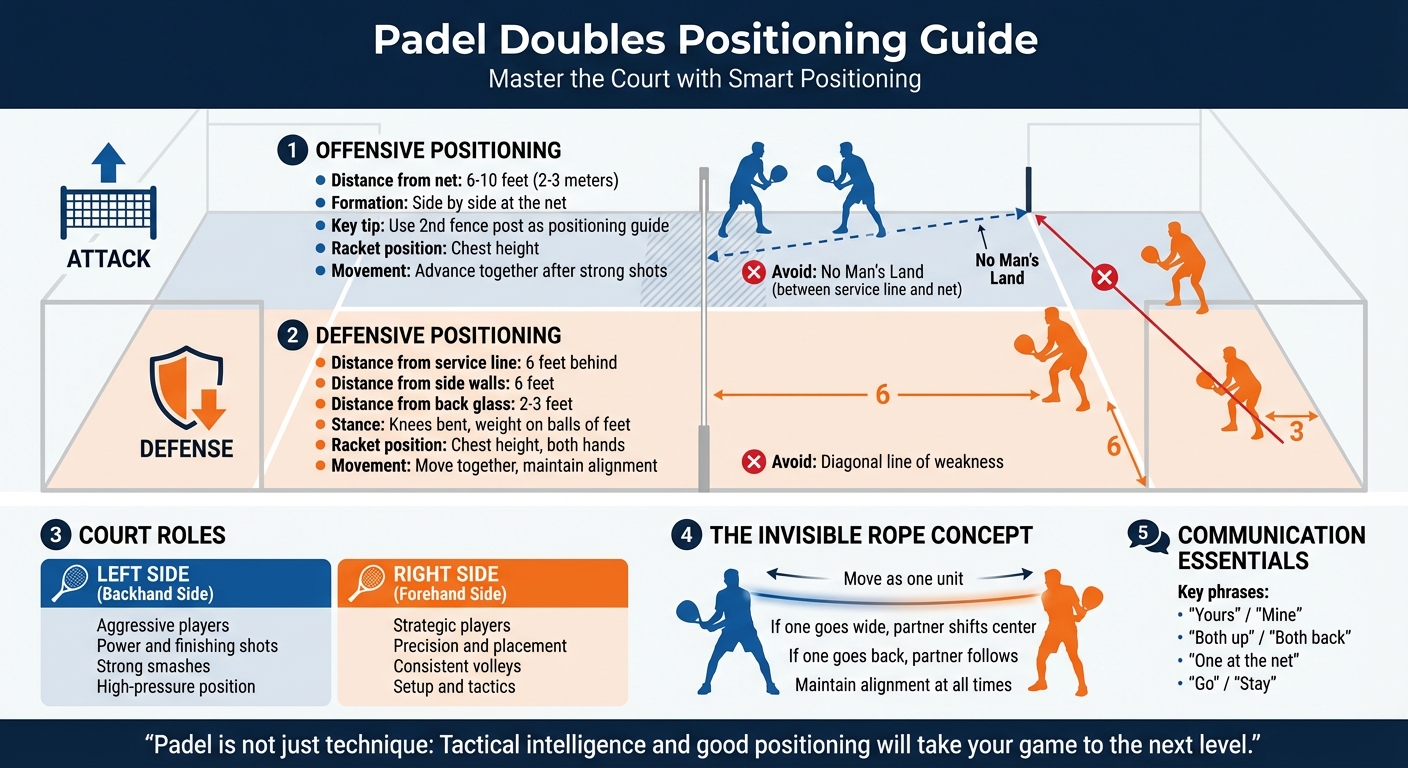
Padel Doubles Positioning Guide: Offensive vs Defensive Strategies
Offensive Positioning Strategies
The Standard Attack Formation
When you're on offense, controlling the net is key to winning points. Both players should position themselves about 6 to 10 feet from the net (roughly 2–3 meters), standing side by side [1][5]. This distance strikes the perfect balance: you're close enough to apply pressure with aggressive volleys, but far enough back to defend against lobs effectively.
"The net is the dominant position. It's the area where you can attack and win the most points."
– Lucas Sánchez, Founder, SimplePadel [5]
A good tip? Use the second post of the side wall fence as a guide for your ideal positioning [5]. This helps you avoid creeping too close to the net, where lobs can catch you off guard, or staying too far back, which weakens your offensive impact. Keep your racket at chest height and stay light on your feet for quick volleys [1].
Once you're at the net, moving in sync with your partner is crucial for maintaining pressure.
Moving to the Net as a Team
Getting to the net isn't about rushing forward recklessly - it’s about coordinated movement as a team. The best time to advance is after hitting a shot that forces your opponents into a defensive position, like a deep serve, a strong bandeja, or a well-placed lob that drives them toward the back glass [3][5]. After serving, move forward immediately and stay aligned with your partner [5].
Teamwork is everything. Both players need to move together to avoid leaving gaps that opponents can exploit with cross-court shots [5]. By advancing as a unit, you maintain balance and ensure all angles are covered.
Avoiding "No Man's Land"
To complement your net play, steer clear of awkward court zones. The area between the service line and the net, often called "No Man's Land", is a tricky spot where points can easily slip away [5]. Here, you're too far back to execute sharp volleys and too far forward to handle balls rebounding off the back glass with ease. If you find yourself in this zone, hit your shot and quickly decide: either advance to the net or retreat to the baseline [5][7]. The key is not to linger - regain a strong position as soon as possible.
sbb-itb-5591e69
Padel Tactics: Moving As A Pair
Defensive Positioning Strategies
While aggressive net play often secures points, a strong defensive game is just as crucial for maintaining control on the court.
The Base Defensive Position
When you're under pressure and away from the net, your base defensive position should be about 6 feet behind the service line and 6 feet from the side walls. This positioning gives you enough space to handle fast drives while allowing time to read ball rebounds off the back glass [5].
"Understanding where to be on the court at any given time can make the difference between winning and losing points."
– Rodrigo Banzer, Padel39 [1]
To maximize reaction time, stand roughly 2 to 3 feet from the back glass. This distance is key - too close, and you'll feel rushed; too far, and controlling balls rebounding off the wall becomes tricky [3]. Keep your knees bent, weight on the balls of your feet, and hold your racket at chest height with both hands. When faced with a powerful shot, let the ball bounce off the back wall to slow it down, giving you a better chance to execute a controlled return [1].
Moving Together During Defense
In padel, defense is a team effort. You and your partner need to move in sync. If one player is pulled wide to retrieve a ball, the other should shift toward the center to cover the gap [5]. Just like with the "invisible rope" concept in offense, staying aligned on defense is essential to avoid leaving openings for your opponents to exploit [4].
"Padel is played in pairs, which means you must act as a single unit with your partner. The fundamental principle is simple: always maintain alignment."
– StockPadel [3]
Avoid creating a "diagonal line of weakness" - a situation where one player is at the net while the other defends at the back. This staggered positioning leaves a large gap that opponents can easily target with cross-court shots [5]. If your partner moves back to defend, you should do the same. This coordinated movement helps you handle lob situations more effectively.
Handling Lobs and Defensive Transitions
When your opponents play a lob, quick decision-making is critical. If the lob is within reach, attack with a bandeja and immediately return to the net to maintain your offensive position [6]. However, if the lob is deep and forces you far back, accept the defensive role and allow your opponents to take control of the net [6].
"The net position is only endangered if the defending team succeeds in producing an effective lob."
– Andoni Bardasco, Former World Padel Tour Player [6]
During these transitions, clear communication with your partner is vital. Use the time the ball is in the air to discuss opponent positioning and adjust your strategy [5]. From the back, your goal is to use high defensive lobs to push aggressive net players backward, creating opportunities to reclaim the net and shift back to offense [5]. Also, consider weather conditions - move slightly forward in hot weather, while colder conditions may require staying closer to the back wall [5].
Assigning Roles Between Partners
Deciding who plays which side of the court can make or break your performance, especially when playing at top UK padel locations. It all comes down to leveraging each player’s strengths, playing style, and even handedness.
Left-Side vs. Right-Side Roles
The left side - often the backhand side for right-handed players - is a high-pressure position. It’s ideal for players who thrive on aggression and have the ability to finish points with power. If smashing and controlling rallies are your strengths, this is likely your spot [2].
"The left side is generally occupied by more aggressive players who can take charge of the court. If you like to dominate points, go for strong smashes, and finish with powerful shots, this is your spot."
– Ace One [9]
On the flip side, the right side, also known as the forehand side, emphasizes precision and strategy over brute force. This position suits players who excel at consistent volleys, smart placement, and setting up plays. If you’re the type to focus on tactics and create opportunities for your partner, the right side is your natural fit [2].
"Playing on the right side means being the team strategist. Your role is to create opportunities for your partner to finish the point. Placement, angles, and consistency are your key weapons."
– Ace One [9]
Handedness also plays a big role in deciding court positions. For the best synergy, pair a right-handed player on the left with a left-handed player on the right. This alignment directs both forehands toward the center, giving your team a strong edge for overheads and smashes [2]. If both partners are right-handed, assign the left side to the player with a stronger backhand and more aggressive style. Meanwhile, the right side should go to the player who’s more consistent and tactical.
These roles aren’t just about individual strengths - they’re the building blocks of your team’s strategy.
Flexibility in Role Assignments
While having defined roles is important, sticking to them too rigidly can hurt your game. Flexibility is key. Switching sides mid-point can help you maintain court coverage when the dynamics shift [2][8]. You can also adapt your formation based on skill levels. For example, the Parallel System, where both players move forward and backward together, works well if both partners have similar abilities [2]. If one player is stronger at the net while the other excels in the backcourt, a staggered system - one at the net and one at the baseline - might be a better fit [2].
Practicing both roles during training sessions can also improve your versatility and overall court awareness. This adaptability allows you to counter opponents who might try to exploit a particular weakness by swapping positions mid-match. The more flexible your approach, the harder it will be for your opponents to find gaps in your strategy.
Communication for Better Positioning
Good communication is the backbone of effective teamwork. When both players are clear on who’s taking the shot and where opponents are positioned, you move together seamlessly - avoiding overlaps and missed opportunities.
"Verbal communication transcends the mere exchange of words between players; it serves as a pivotal tool for keeping both players abreast of crucial elements such as opponent positions, planned moves, and strategic considerations."
– Ángel González, Professional Padel Coach [10]
In high-pressure moments, a quick update about the opponents’ positions can make all the difference. For instance, if your partner is chasing a lob and can’t see the net, they’re essentially playing blind. A simple call like "both up", "both back", or "one at the net" gives them the information they need to make a confident and timely return.
Verbal Cues and Signals
Short and clear phrases like "yours" or "mine" eliminate confusion about who takes the shot. Agreeing on a default plan for middle balls before the match can reduce the need for constant chatter during play.
"Simple calls like 'yours' or 'mine' can clarify responsibilities and avoid overlapping coverage."
– Rodrigo Banzer, Padel Coach [11]
But communication doesn’t stop at basic calls. Keeping each other updated on opponent positions during rallies is just as crucial. For example, if one player moves to retrieve a lob near the back wall, the partner at the net should announce where the opponents are positioned. This allows the player retrieving the ball to decide on the best return without hesitation. Commands like "go" or "stay" also help coordinate movement - whether advancing after a successful lob or holding back under pressure.
Even before the point begins, servers can communicate their intentions by calling out serve directions like "wide", "to the T", or "at the body." Some teams take it a step further by using subtle hand signals behind their back. In the heat of fast-paced exchanges, making these calls as soon as the ball leaves the opponent’s racket can give your team a critical edge.
Take the time to solidify these cues with your partner before the match starts to ensure smooth coordination during play.
Pre-Match Discussions
Strong communication starts before the first serve. Pre-match discussions are an opportunity to map out your strategy and align on critical details. Decide who will play which side based on your strengths and handedness, and agree on whether you’ll use a Parallel System (moving together) or a Staggered System (one at the net, one back) depending on your skill sets.
Establish a default plan for handling middle balls so you don’t waste time deciding who takes each shot. Discuss defensive transitions, particularly how you’ll handle lobs. Will both players retreat, or will one cover the overhead while the other stays forward? If you’re aware of your opponents’ tendencies - like favoring shots down the middle - adjust your positioning strategy accordingly.
"Talk it through with your partner and make sure that you are communicating clearly at all times so that you remain adaptable and work effectively as a team."
– Rodrigo Banzer, Padel39 [1]
Use these pre-match talks to standardize verbal cues. Agree on straightforward phrases like "I’m going up", "stay back", or "I’ve got the wall" to minimize confusion during rallies. Remind each other to maintain the "invisible rope" - if one player is forced wide or back, the other should shift to cover the open space. These quick conversations set a solid foundation for teamwork, ensuring you’re in sync from the very first point.
Conclusion
Putting It All Together
Getting the hang of padel doubles positioning boils down to three key ideas: move as one with your partner, stay aligned, and keep the communication flowing. Think of it as a dance - whether you're pressing at the net or holding the baseline, you and your partner should move in harmony. Steer clear of "no man's land", and prioritize reaching the net after setting up a solid shot, as that’s where most points are won.
"Padel is not just technique: Tactical intelligence and good positioning will take your game to the next level."
– Stock Padel [3]
Clear, consistent communication is essential - simple calls like "yours" or "mine" go a long way. Watching pro matches can also help you understand spacing and how to cover the court effectively.
Padel is often compared to chess, but with a racket. Every step, every shot, and every decision should aim to close gaps and keep the pressure on your opponents. Even the most skilled players can struggle when their positioning is off. Stay alert, read the game, and be ready to adapt to what’s unfolding on the court.
Find Padel Courts Near You
The best way to sharpen these strategies is by putting them into practice on the court. Whether you're just starting out or fine-tuning advanced techniques, having access to quality facilities can make all the difference.
Check out Padel and Tennis Courts in the UK to find courts in London, Surrey, and beyond. Their directory offers details on training facilities, coaching sessions, and upcoming tournaments - everything you need to refine your doubles game and take it to the next level.
FAQs
What is the 'Invisible Rope' strategy in padel doubles, and how does it improve teamwork?
The Invisible Rope is a teamwork technique in padel doubles designed to keep partners moving in harmony throughout a rally. Picture an imaginary line connecting you and your partner - when one player advances toward the net, the other moves up as well. If one player retreats to defend, both shift back together. This synchronized movement helps cover the court efficiently, reduces gaps, and puts opponents in tougher positions.
By paying attention to subtle cues like positioning, eye contact, and your partner’s movements, the Invisible Rope allows for seamless transitions and smoother lateral shifts. Teams that embrace this approach can better guard against weak spots, maintain pressure on opponents, and increase their chances of winning points through unified play.
What are the best strategies for dealing with lobs in Padel doubles?
To manage lobs effectively in Padel doubles, timing and positioning are critical. When the lob is high and within your reach, go for an overhead smash. Use a continental grip, step into the right position, and swing with a throwing motion to deliver both power and precision. Aim for spots like the side or back glass to make it harder for your opponents to return.
For deeper lobs or those near the side glass, quickly retreat behind the service line. Stay balanced, keep your racket ready, and choose a smart response - either a controlled drive or a well-placed lob to reset the rally. Spotting lobs early can make all the difference. Pay attention to your opponent’s racket angle and body language, and work in sync with your partner to maintain solid court coverage. Clear communication, such as calling out "lob!" or "back!", ensures both players are on the same page and avoids unnecessary confusion.
By practicing these techniques regularly, you'll build confidence and consistency. Check out local Padel courts to sharpen your skills and enjoy the game even more.
How do doubles partners decide who plays on the left or right side in Padel?
Choosing positions in Padel doubles - whether to play on the left or right side - comes down to each player's strengths and style of play. The left side is often seen as the more offensive role, demanding a solid backhand, powerful smashes, and the ability to deal with lobs in the middle of the court. On the other hand, the right side suits players who thrive on precision, steady volleys, and setting up opportunities for their partner.
Handedness plays a big role in this decision. Left-handed players are usually positioned on the right side to keep their forehand in the center of the court, while right-handed players decide based on their skills - those with an aggressive game might favor the left, while those with stronger defensive abilities often prefer the right. If one partner excels in overhead shots like smashes or bandejas, they’re likely a better fit for the left side. Meanwhile, the player with a sharp backhand volley or a reliable return of serve is a natural choice for the right. Physical fitness is another consideration since the left side often demands more movement.
To figure out the best setup, partners should experiment by switching sides during practice or early matches. Testing both positions helps pinpoint what works for the team and builds synergy. Once the ideal arrangement is found, you can play to your strengths, balance each other’s abilities, and grow as a duo.