We may earn a commission if you buy through links on this page. It doesn't change our picks. How we make money.
Padel grips and tennis grips may look similar, but they serve different purposes based on the unique demands of each sport. Whether you are looking to book a padel court or a tennis court, understanding these differences is essential for your game. Here's a quick breakdown:
- Thickness: Padel grips are thicker (1.2–3.5 mm) to reduce vibrations caused by solid, stringless rackets. Tennis grips are thinner, focusing on precision and feedback since strings absorb most of the impact.
- Surface Texture: Padel grips often feature ergonomic patterns for better shock absorption and grip. Tennis grips prioritize moisture control with flat, perforated, or treaded designs.
- Sweat Management: Padel grips emphasize prolonged sweat absorption, while tennis grips balance durability and moisture-wicking.
- Customization: Padel rackets use standard handles, requiring players to stack overgrips for the correct fit. Tennis rackets come in pre-sized handles, with grip size adjustments made via overgrips.
Quick Tip: Replace overgrips every 5–10 hours of play to maintain performance and comfort.
Quick Comparison
| Feature | Padel Grips | Tennis Grips |
|---|---|---|
| Thickness | 1.2–3.5 mm | Thinner for precision |
| Texture | Ergonomic patterns | Flat, perforated, or treaded |
| Sweat Management | High sweat absorption | Durable, moisture-wicking |
| Customization | Add overgrips for fit | Pre-sized handles |
| Vibration Control | Essential due to solid rackets | Strings absorb most impact |
Choosing the right grip is key to comfort, control, and injury prevention. For heavy sweaters or joint pain, opt for absorbent grips or ergonomic undergrips.
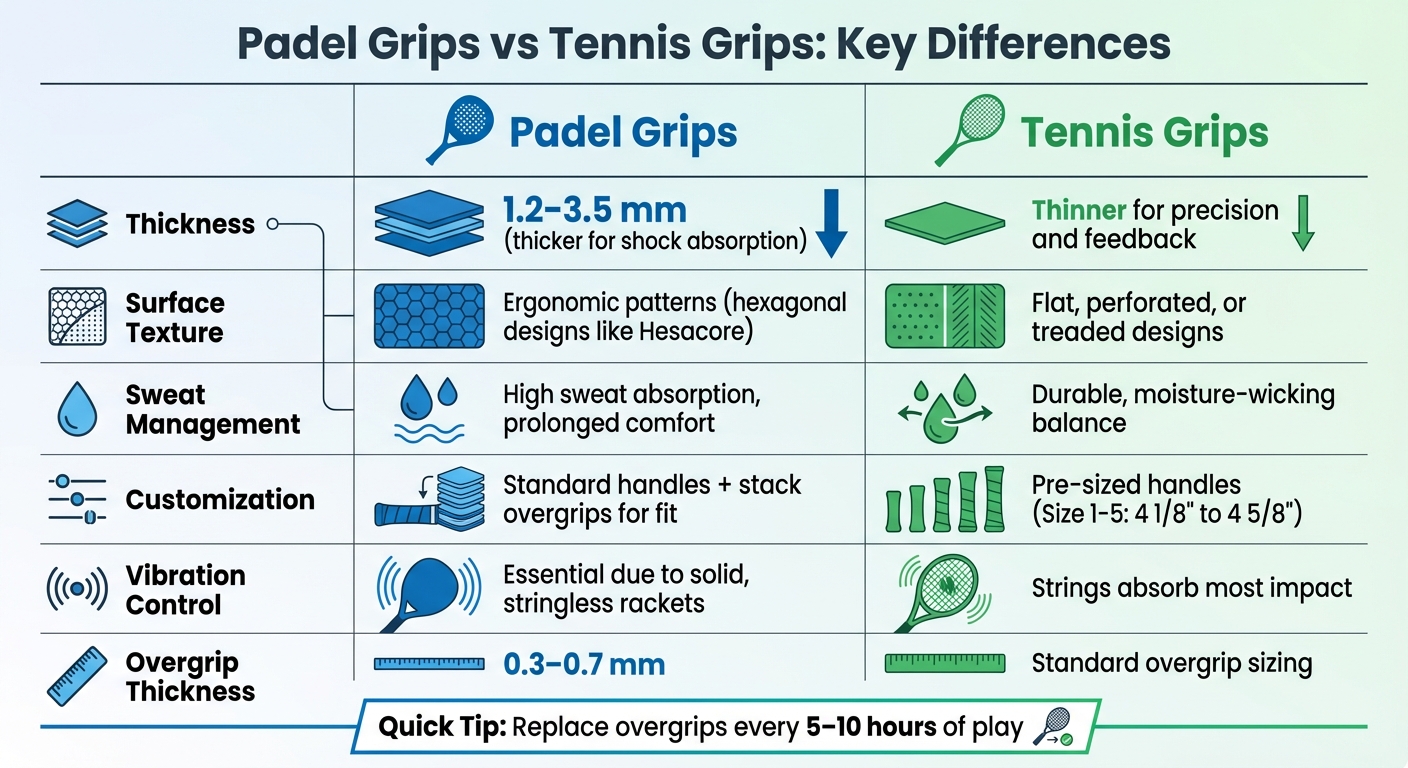
Padel vs Tennis Grips: Key Differences Comparison Chart
Main Differences Between Padel and Tennis Grips
Thickness and Cushioning
Padel rackets feature a solid, stringless design made from materials like carbon fiber or fiberglass. Because of this, their grips need extra thickness - typically ranging from 1.2 mm to 2.5 mm, with premium options going up to 2.0 mm to 3.5 mm - to cushion the impact of the ball [5]. In contrast, tennis rackets have strings that absorb much of the initial shock, allowing for thinner grips that focus more on providing feedback rather than shock absorption.
Another key difference lies in handle sizing. Tennis rackets come with varied handle sizes pre-fitted, while padel rackets require players to layer overgrips to achieve their preferred circumference. It’s common for padel players to stack multiple overgrips to get the right fit [1][8].
A quick way to check your grip size for both sports is the pinky test: when gripping the racket, there should be just enough space to fit your pinky finger between your fingertips and palm. If there isn’t, the grip is too small [1].
Beyond thickness, the grip's surface texture plays a major role in performance.
Texture and Surface Feel
Padel grips often come with ergonomic textures tailored to the sport's fast-paced, sharp movements. For instance, the Bullpadel Hesacore grip features a hexagonal pattern designed to reduce vibrations and improve grip ergonomics [2]. Some padel grips, like the NOX Custom Grip, even include adjustable rings for a more personalized fit [2].
Tennis grips tend to stick with traditional surface designs, such as flat finishes, tread patterns, or perforations that help manage moisture [7]. Both sports offer grips categorized as "tacky" (providing a sticky feel right away) or "absorbent" (which get grippier as they soak up sweat) [2][5]. A standout example is the Tourna Grip, known for its ability to improve grip as it absorbs moisture, making it especially useful in humid conditions [2].
Padel overgrips are generally thinner, ranging between 0.3 mm and 0.7 mm, offering comfort and grip without adding unnecessary bulk. This makes them easier to apply and trim compared to some tennis or badminton grips [2][5].
These textural differences align with how each sport demands grip performance, particularly in managing sweat and ensuring durability.
Sweat Absorption and Durability
Padel grips focus on prolonged sweat absorption and comfort, while tennis grips emphasize durability and efficient moisture-wicking [9]. Padel grips often use absorbent polyurethane (PU) materials, which provide a soft, comfortable touch during long matches. On the other hand, tennis grips are designed to endure high levels of abrasion caused by powerful shots and greater impact forces [9].
There’s a trade-off between tackiness and sweat absorption: tacky grips give you a solid, controlled hold but don’t absorb much sweat, while absorbent grips wick away moisture but may feel slippery when dry [5][1]. On average, an overgrip should last about 10 hours of play before it starts losing its effectiveness [1]. For reference, an overgrip typically weighs around 10 grams, while a replacement grip weighs closer to 20 grams [4].
For players who sweat heavily, additional products like Grippy Gripz (anti-sweat gel), Gorilla Gold (resin cloth), or 4ON Total Grip spray can help enhance grip performance [1].
sbb-itb-5591e69
How to Choose the Right Grip for Your Sport
Size and Fit Considerations
Tennis rackets come in five grip sizes, ranging from Size 1 (4 1/8") to Size 5 (4 5/8") [13]. Picking the correct size is important because once you've chosen a grip, you can't make it smaller. On the other hand, padel rackets typically have a single standard handle that's intentionally narrow, allowing players to customize the thickness by adding overgrips [20,21].
To find your tennis grip size, measure from the bottom crease of your palm to the tip of your ring finger. For example, a measurement of 4 3/8" corresponds to a Size 3 grip [10]. You can also use the index finger and pinky tests: hold the racket with a handshake grip, and check that there's just enough space between your fingertips and palm to fit one finger [19,20,22]. If you're between sizes, it's better to go smaller since an overgrip can increase the size by about 1/8", while reducing the grip size is nearly impossible [13].
Your playing style also plays a role in selecting the right grip. Power hitters and aggressive players often prefer thicker grips for added stability during forceful shots, while players focused on control lean toward thinner grips for better wrist mobility and quicker transitions between shots [19,21]. For padel, women typically add 0–1 overgrip, while men use 1–3 to achieve the right fit [12]. Keep in mind, the handle thickness for padel rackets cannot exceed 38 millimeters (about 1.5 inches) [12].
"A too-narrow grip, along with improper technique, is the major cause of what is known as 'padel elbow' (tennis elbow)." - Padelstore [11]
Using a grip that's too small can lead to over-squeezing, which causes fatigue and raises the risk of injuries. Ideally, your grip pressure should feel firm but not overly tight - around a 4 or 5 on a scale of 1 to 10 [6].
Once you've nailed the grip size, the next step is to choose the right material to match your performance needs.
Material Composition and Options
Padel grips are generally made from polyurethane (PU), valued for its durability and tackiness. Many players also use foam or rubber undergrips, such as Hesacore, to absorb vibrations before adding an overgrip [3,21]. In tennis, grips are available in synthetic PU or leather. Leather grips offer a firmer feel and more pronounced bevels, making it easier to switch between grip styles [3,19].
For padel, undergrips made from rubber or EVA foam help absorb shocks since padel rackets lack strings that would normally soften the impact [2,21]. This makes the grip a key factor in reducing joint strain. If you tend to sweat or play in humid environments, opt for absorbent or dry overgrips that wick moisture effectively [19,20].
Frequent players - those hitting the court three times a week - can expect to spend between $22 and $135 annually on grip replacements [4]. For the best performance, it's recommended to replace your overgrip every 5 to 10 hours of play [3,7].
Tips for Players Who Play Both Sports
If you play both tennis and padel, balancing grip size, material, and wrapping technique is essential. Brands like Wilson and Tourna offer overgrips designed to combine tackiness with moisture absorption, making them versatile for both sports [3,6]. Former tennis players transitioning to padel often prefer a thicker grip to counteract the increased vibration in padel [2,3].
How you wrap the grip also matters. Tennis players usually apply overgrips with minimal overlap, while padel players may use a 50/50 overlap to create the desired thickness [1]. If you rely on precise grip changes for tennis styles like Eastern or Semi-Western grips, leather replacement grips are a good choice because they provide sharper edge definition [3,19]. However, in padel, where the Continental (hammer) grip is used for most shots, edge definition is less critical [6].
"A good overgrip should prevent the racket from sliding in your hand... individual preference has a lot to say in the choice of grip thickness, as e.g. former tennis players may prefer a somewhat thicker grip." - Kasper Pedersen, Padel Expert [1]
In humid conditions, the Tourna Grip becomes more effective as it absorbs moisture, making it a great option for players switching between indoor tennis and outdoor padel and tennis courts [2]. Wilson also suggests replacing your padel grip as many times per year as you play per week - for instance, if you play twice a week, replace your grip twice a year [14].
Back to Basics: The Grip - Tennis to Padel
Health and Performance Effects
The impact of grip material and design goes beyond just comfort - it plays a key role in both health and performance on padel and tennis courts.
Using a grip that's too narrow can force you to over-squeeze, which often leads to "padel elbow", a condition similar to tennis elbow. This excessive squeezing increases muscle fatigue and puts extra strain on your tendons. As Julien Bondia, a Padel Teacher, points out:
"An unsuitable handle thickness can lead to elbow tendonitis" [8].
Unlike tennis rackets, padel rackets don't have strings to absorb shock, meaning they naturally produce more vibration. This makes vibration dampening essential for protecting your joints. Products like the Bullpadel Hesacore undergrip use ergonomic designs and rubber materials to reduce vibrations before they reach your arm and shoulder [2]. Without proper cushioning, these vibrations can lead to joint stress and discomfort. Beyond vibration control, sweat management is another critical factor for maintaining grip stability and avoiding injuries.
Sweat can make your grip slippery, forcing you to squeeze harder to maintain control. This over-gripping increases strain on your forearm and can throw off your stroke precision. If your racket starts slipping during play, it's likely time to replace your overgrip [1].
Maintaining consistent grip pressure is equally important. Choosing ergonomic undergrips and keeping your grip in good condition can help you achieve a balance between firmness and relaxation. Ideally, your grip pressure should feel firm yet relaxed - around a 4 or 5 on a scale of 1 to 10 [6]. As Padel Tennis Racket explains:
"A relaxed yet firm grip reduces tension in your wrist, elbow, and shoulder. Mastering the grip doesn't just help you play better" [6].
If you're experiencing joint pain, switching to an ergonomic undergrip can make a big difference. These grips reduce the effort needed to hold the racket and help absorb impact shocks, allowing you to play longer without sacrificing performance [2]. Additionally, holding your racket with your non-dominant hand between points can help relieve muscle tension [15].
Conclusion
From the comparisons above, it’s clear that the differences between padel and tennis grips lie in their design, materials, and how they’re tailored to enhance comfort and control. Padel grips are built to absorb vibrations, addressing the rigid nature of padel rackets, while tennis grips emphasize precision through thinner profiles.
Selecting the right grip is about more than just comfort - it’s also about preventing injuries like padel elbow and maintaining control during play. As The Padel Directory highlights:
"Choosing the best padel grip is essential for both comfort and performance. The right grip can improve your control, power, and overall feel during play, whilst also preventing injury" [2].
If joint pain is an issue, ergonomic undergrips can help by reducing vibrations before they affect your elbow [1][2]. You can also experiment with different textures and thicknesses to find what works best for you - tacky grips enhance control, while absorbent ones are ideal for players who sweat heavily [1][2]. Overgrips are affordable, typically priced between $2.25 and $7.00, making it easy to test and refine your preferences [4][1]. For optimal performance, replace your grip every 5 to 10 hours of play [1][3].
Once you’ve found your ideal grip, test it out on high-quality courts to fine-tune your technique and build confidence. If you're in the UK, check out the Padel and Tennis Courts directory to discover excellent venues for practice and play.
FAQs
Why choose a thicker padel grip instead of a thinner tennis grip?
Choosing a thicker padel grip instead of a thinner tennis grip often boils down to comfort, control, and injury prevention. For players with larger hands or those who prefer a softer, more cushioned feel, a thicker grip offers better stability and can enhance control during the game.
Beyond comfort, thicker grips can help reduce hand fatigue and lower the chances of injuries like tennis elbow or tendinitis. They’re also great at absorbing vibrations, which can ease strain on your arm and make long or intense matches more comfortable. Many players tweak their grip size by layering on overgrips, making it easy to find the perfect fit for their hand size and playing style.
How do ergonomic patterns on padel grips improve gameplay?
Ergonomic designs on padel grips can make a big difference in how you play. They offer better control, comfort, and stability by reducing slippage, even during intense rallies or when your hands get sweaty. This ensures you can keep a firm grip on your racket at all times.
These grips also help by absorbing vibrations and providing a cushioned or slightly tacky feel. This not only enhances precision but also reduces fatigue, which is especially helpful during high-energy matches. Some grips go a step further, easing the strain on your arm, which can make playing more comfortable and may even lower the risk of injuries. In short, ergonomic grips are a game-changer for maintaining consistent performance and making your time on the court more enjoyable.
Why should I replace my overgrip every 5 to 10 hours of play?
Replacing your overgrip every 5 to 10 hours of play is key to keeping your grip, comfort, and control in top shape. As you play, grips naturally wear down, becoming slick and less effective at absorbing sweat - issues that can directly affect your performance on the court.
A fresh overgrip not only provides better sweat absorption but also gives you a more secure hold on your racket. This can make all the difference, especially during high-pressure moments, helping you stay confident and avoid slips during intense matches.