Buying the wrong padel net branding strip is easy: if the size is off, the print file is weak, or the fixing method is wrong, the strip can sag, wrinkle, fade, or wear the net out fast.
If I were buying one, I’d check five things first: fit, material, print method, artwork files, and outdoor setup. A regulation padel net is 10 meters / 32.8 feet long, and most strips are 13 to 18 cm / 5 to 7 inches wide, so sizing comes first. After that, I’d match the strip to the top UK padel court locations: PVC for lower-cost short runs, polyester for more outdoor use, and mesh for windy sites.
Here’s the short version:
- Start with net size: the strip has to fit a 10 m (32.8 ft) net cleanly
- Pick the right material: PVC, polyester, or mesh based on sun, wind, and use
- Choose a layout: centered logo, repeated logos, or multi-sponsor panels
- Send vector artwork: AI, EPS, PDF, or SVG for clean print
- Set colors clearly: use Pantone or CMYK, not color names
- Check the fixing method: eyelets with plastic ties are common for club and event use
- Plan for outdoor court wear: UV-treated material, rust-resistant hardware, and dry storage matter
- Confirm the order details: proof, lead time, included hardware, and final installed size
A few numbers matter more than most buyers think. The net height is 0.88 m (34.6 in) at the center and 0.92 m (36.2 in) at the posts, which affects how the strip sits once installed. Standard lead time is often around 15 business days, plus shipping, so timing should be locked in before you approve artwork.
If you want the cleanest result, I’d treat this like a print-and-fit job, not just a banner order. Get the dimensions right, use vector files, approve a proof, and match the fixing method to the court. That’s what keeps the strip looking straight, sharp, and usable event after event.
What a Padel Net Branding Strip Is
A branding strip is a removable banner that fits over the net headband. It gives clubs and sponsors a bigger full-color space for logos, names, and campaign artwork. The net headband itself is a permanent 5 cm (2-inch) white band built for tension, not display. [4][7] The strip sits over that band and turns it into a full-color ad space.
Most strips are 10 meters (32.8 feet) long and 13 to 18 cm (5 to 7 inches) wide. They usually come with reinforced eyelets and plastic cable ties, so staff can put them on or take them off without changing the net. [1] That makes life a lot easier when you book a padel court at clubs and events. You can switch sponsors, cover old logos, or update the court look without buying a new net.
Because the strip fits over the headband, size matters. If the fit is off, the strip can bunch up, sag, or sit awkwardly across the net.
Net Size and Headband Limits
A regulation padel net is exactly 10 meters (32.8 feet) long. [5] FIP rules also set the net height at 0.88 meters (34.6 inches) in the center and 0.92 meters (36.2 inches) at the posts. [5] Those measurements shape the strip size too, since the strip needs to line up with the full net length and fold neatly over the headband.
Before you place an order, check both the strip length and width. A strip that matches the headband properly will sit cleanly and look far better once installed.
Strip Materials for Club and Event Use
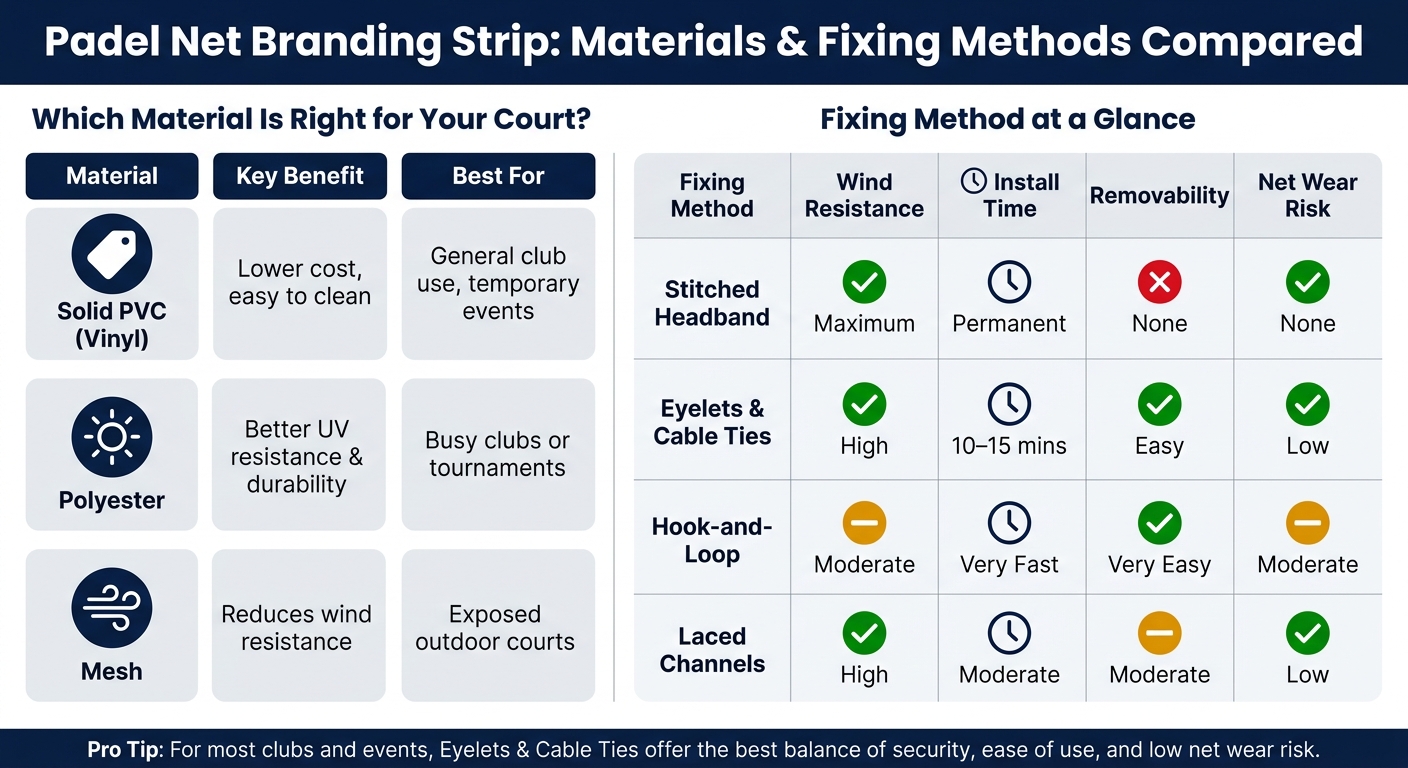
Material choice comes down to budget, sun exposure, and wind. PVC is the lower-cost option, polyester holds up better in the sun, and mesh works well on outdoor courts where wind can be a headache. [7]
| Material | Key Point | Best For |
|---|---|---|
| Solid PVC (Vinyl) | Lower cost and easy to wipe clean, but may fade after long UV exposure | General club use, temporary events |
| Polyester | Better UV resistance and durability for frequent outdoor use | Busy clubs or tournaments |
| Mesh | Helps cut wind resistance and reduce stress on the posts | Exposed outdoor courts |
Once you've picked the material, the next job is matching the net size, layout, and print setup. After that, the artwork and print method need to fit the strip dimensions.
sbb-itb-5591e69
Size, Layout, and Print Setup
How to Measure the Net and Plan the Branding Area
Measure the headband first and confirm the printable face before you approve any artwork for Padel courts in the UK. The strip has to fold cleanly over the headband, so make sure the 13 to 18 cm (5 to 7 in) strip width fits your net before you lock in the final dimensions [1][4].
Once the size is set, pick one of these three layouts:
- Single centered logo - high visibility, one clear focal point for a single brand, low artwork complexity, and only one vector file needed
- Repeated logos - high visibility from multiple angles, moderate complexity, and repeat spacing required
- Multi-sponsor panels - visibility depends on placement, high complexity, and multiple files plus proofs required
If you have one sponsor, a centered logo usually makes the most sense. For multi-sponsor events, repeated logos or panel layouts are the better fit. Pick the layout before you ask for proofs, because it changes both file count and print setup.
Print Methods and When to Use Each
Use digital printing for full-color artwork, screen printing for simple shapes, and heat transfer only for short-term use. Digital printing handles full-color sponsor logos well [3].
Screen printing works best for simple, flat designs with clean edges. But there’s a catch: mesh can interrupt the image because the holes break it up, which makes this method less suited to that surface [6].
Logo Files and Color Matching
Send your supplier vector files: AI, EPS, print-ready PDF, or SVG [2][6]. These file types scale cleanly, which matters when the strip needs to stay sharp from a distance and still look good on camera. Low-resolution web images usually fall apart in print, so ask for vector art instead.
Color matching is where many orders slip off track. Send Pantone (PMS) numbers or exact CMYK values instead of basic color names [6]. Pantone colors can shift from one material to another, so approve a digital proof first. If brand color is a big deal, ask for a sample before production [1][6].
After the artwork is approved, the next choice is how the strip attaches and how well it holds up outdoors.
Fixing Methods and Outdoor Performance
Padel Net Branding Strip: Materials & Fixing Methods Compared
Eyelets, Hook-and-Loop, and Other Fixing Options
Once the artwork is approved, the next step is picking a fixing method that stays straight in the wind and is still easy to change when you need to.
For most clubs and events in the UK, eyelets with plastic cable ties are the standard pick. The strip folds over the net headband, and plastic mini cable ties pass through reinforced eyelets along the bottom edge. Use plastic cable ties instead of metal clips so you don’t rub and damage the net twine.
If the strip is staying in place for long-term club use, a stitched headband is the most secure choice. The trade-off is simple: it can’t be moved from one sponsor to another.
| Fixing Method | Wind Resistance | Install Time | Removability | Net Wear Risk |
|---|---|---|---|---|
| Stitched Headband | Maximum | Permanent | None | None |
| Eyelets & Cable Ties | High | 10–15 mins | Easy | Low |
| Hook-and-Loop | Moderate | Very Fast | Very Easy | Moderate (can snag mesh) |
| Laced Channels | High | Moderate | Moderate | Low |
On outdoor courts, fixing the strip in place is only part of the job. It also needs to deal with sun, rain, and being handled again and again.
Hook-and-loop fastener is handy when you need fast turnover, but it doesn’t hold up in wind as well as tied eyelets. It can also snag the mesh if you’re not careful.
Weather Resistance, Cleaning, and Storage
For outdoor use, ask for UV stabilization. Without UV stabilization, outdoor prints fade and the material becomes brittle [5].
For the base material, specify polyester for outdoor courts. Polyester holds its shape and has low moisture absorption, which makes it a strong match for outdoor use [8][9]. For the hardware, including eyelets and any tension parts, check that they’re rust-resistant. Internal tension cables should use plastic-coated galvanized steel to help stop corrosion in damp conditions [5].
After each outdoor event, wipe the strip down to remove dirt and grit, then let it dry all the way before folding it for storage [5]. Check the fold lines and eyelets first, since those areas wear out fastest [5].
These details should be written into the supplier spec.
How to Brief a Supplier and Place the Order
Use the size, material, print, and fixing choices above to put together a supplier brief before you ask for a proof.
Questions to Ask Before You Order
A clear brief saves time and helps you avoid costly reprints. Get these points confirmed by your supplier in writing before you place the order. After that, double-check timing, proofing, and hardware before you give final approval.
- What is the finished size after installation?
- What vector file formats do you accept?
- Can you match Pantone colors across the print and trim?
- Do you provide a digital proof before production starts?
- What is the production lead time after proof approval?
- Confirm whether eyelets and cable ties are included.
- Is the material UV-stabilized for outdoor use?
Planning for UK Clubs, Sponsored Courts, and Events
Timing matters just as much as the brief. If you're ordering for a summer tournament, leave enough time for manufacturer shutdowns and shipping. For event orders, line up the lead time with your install date before you approve artwork.
For sponsored courts, coordinate the strip with other court signage and materials - net post wraps, gate panel wraps, or glass panel banners - so the branding feels like one package instead of a mix of separate pieces. That matters even more when a sponsor has paid for full-court sponsorship and expects the court to look polished from end to end.
Before you send artwork, get written permission for every logo used in the design. Sponsor logos, club crests, and partner marks all need written sign-off before production begins. [6]
Key Checks Before You Buy
Before you approve production, do one last pass on fit, artwork, colors, fixing, and timing.
- Net size confirmed: 33 ft (10 m) length, strip width between 5–7 inches (13–18 cm) [1]
- Artwork ready: Vector file supplied [6]
- Colors specified: Pantone, CMYK, or RGB codes provided [6]
- Fixing method agreed: Eyelets with plastic cable ties or stitched headband [1] [2]
- Proof approved: Digital proof signed off before production starts [1] [3]
- Lead time locked in: Standard production is about 15 working days, plus delivery, mapped against your event or installation date [1] [3]
The best strip balances visibility, durability, and easy installation.
FAQs
How do I know if a strip will fit my net properly?
Check that the strip matches the standard padel net length of 10 meters. Most are made to fold over the existing net band and are usually 13 cm to 18 cm wide.
Before you place the order, confirm how it will be fixed in place, such as with eyelets and cable ties. Also ask for a final design proof so you can review the dimensions and layout.
Which material is best for outdoor courts?
For outdoor padel courts, polyester is widely seen as the best material for net headbands. It holds up well over time, resists UV damage, and stands up to rain, sun, and rough outdoor conditions.
For the net body, go with high-density polypropylene or polyethylene that includes UV stabilizers. It’s also smart to check that the tension cables use plastic-coated galvanized steel, which helps prevent rust. And make sure all materials meet FIP rules for outdoor use.
What logo files should I send?
For the best results, send your logo as a vector file: AI, EPS, PDF, or SVG. Those file types stay sharp when resized, which matters a lot in print.
If you don’t have a vector file, high-resolution artwork is usually needed. Low-quality JPEGs or images pulled from a website often look fine on a screen, but they usually won’t print cleanly.
After you send your file, the supplier should provide a design proof for approval before production. That gives you a chance to check the layout, size, and placement before anything moves forward.
If you’re not sure whether your file will work, most suppliers can help convert it or point you in the right direction.