I’d choose padel eyewear by checking impact protection first - not tint or style. Look for a complete frame-and-lens rating, such as ASTM F803, and confirm with the manufacturer that it covers padel. UV400 alone doesn’t mean impact protection.
Here’s my buying checklist:
- Lenses: Choose polycarbonate or Trivex; check that any finished prescription setup keeps the stated protection.
- Coverage and fit: Look for front and side coverage without blocked side vision, slipping, or pinching.
- Fog control: Check built-in airflow, anti-fog coatings, and cleaning instructions. Never alter the frame or vents.
- Court lighting: Use clear or light lenses indoors and in low light. For sunny courts, check for 100% UVA and UVB protection and a suitable tint.
- Comfort in motion: Test head turns, lunges, and overheads, then check again after sweating.
My final check: <u>the eyewear should stay put and keep my view clear during play</u> - without repeated adjustments.
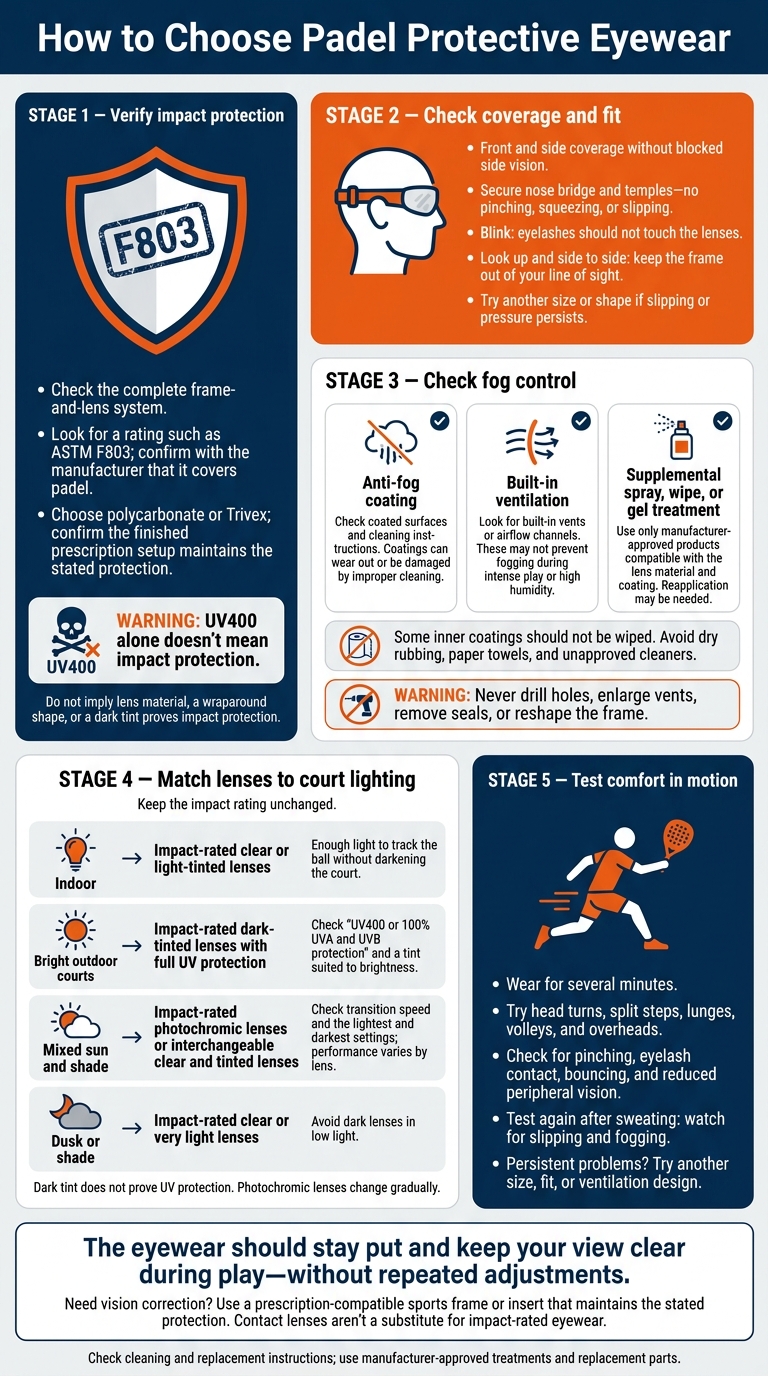
How to Choose Padel Protective Eyewear
Picking the Right Pickleball Safety Glasses | RX Safety
sbb-itb-5591e69
2. Check Coverage and Fit
Choose sports frames made for padel that cover the front and sides of your eyes. A wraparound shape can improve peripheral vision and block wind or debris, but it does not prove impact protection. Coverage matters, while fit keeps you comfortable through fast rallies.
Check Fit and Grip
Try a few quick head turns. Your eyewear should stay put without repeated adjustments.
The nose bridge should rest evenly without pinching. Temple arms should hold securely without squeezing or slipping when you sweat. Tighter isn't always better: aim for a secure fit that doesn't cause discomfort.
Blink to make sure your eyelashes don't touch the lenses. Then look up and side to side to check that the frame stays out of your line of sight. Adjust the nose pads if needed. If the eyewear still slips or pinches, try another frame size or shape.
Once the fit feels secure, check airflow and anti-fog features.
3. Look for Fog Control and Airflow
Once the frame fits securely, check whether the lenses stay clear as you work harder.
Body heat, sweat, and heavy breathing can trap moist air behind the lenses. The resulting fog can make it harder to track the ball and judge rebounds, especially on humid indoor courts. Cold starts and humid outdoor conditions can fog lenses, too.[3][7]
Compare Anti-Fog Features
Before you buy, compare anti-fog coatings, built-in ventilation, and approved treatments. Look for a clearly labeled anti-fog coating and a ventilated sports frame. Check whether the coating covers the inner surface, outer surface, or both - and whether the manufacturer documents how it performs after cleaning.[1][4][6]
| Feature | What to check | Limitation |
|---|---|---|
| Anti-fog coating | Which surfaces are coated and how to clean them | Coatings can wear out or be damaged by improper cleaning. |
| Built-in ventilation | Built-in vents or airflow channels | May not prevent fogging during intense play or in high humidity. |
| Supplemental spray, wipe, or gel treatment | Whether the eyewear manufacturer approves it for the lens material and coating | Compatibility varies, and you may need to reapply it. |
Follow the cleaning instructions exactly. Some inner coatings should not be wiped. Avoid dry rubbing, paper towels, and unapproved cleaners. Use only manufacturer-approved treatments and replacement parts.[5][8][9]
If airflow falls short, never drill holes, enlarge vents, remove seals, or reshape the frame. These changes can weaken protection. If the lenses still fog during warm-up, choose a frame with better built-in ventilation instead of modifying the eyewear.[2][3]
4. Match Lenses to Court Lighting
Keep the impact rating unchanged, and choose a tint that suits your court’s lighting. Once you’ve addressed fog control, check how much light your lenses let through. For outdoor play, look for UV400 or 100% UVA and UVB protection on the label. A dark tint cuts visible light, but it doesn’t prove the lens blocks UV rays.
Compare Lenses for Indoor and Outdoor Play
Choose lenses for the lighting you’ll play in - not the light outside the venue.
| Court conditions | Lens choice | What to check |
|---|---|---|
| Indoor | Impact-rated clear or light-tinted lenses | Lenses should let through enough light to track the ball without making the court look dark. |
| Bright outdoor courts | Impact-rated dark-tinted lenses with full UV protection | Look for UV400 or 100% UVA and UVB protection, with a tint that suits the brightness. |
| Mixed sun and shade | Impact-rated photochromic lenses or interchangeable clear and tinted lenses | Check how fast photochromic lenses change and how dark they get. Both vary by lens. |
| Dusk or shade | Impact-rated clear or very light lenses | Avoid dark lenses, which can make the ball harder to see in low light. |
Photochromic lenses change gradually. Test how long they take to darken and clear, and check whether their lightest and darkest settings suit your courts.
With the tint chosen, test how the eyewear feels during fast movement.
5. Test Comfort During Play
Check the fit while moving - not just standing still. Fast rallies can reveal slipping, bouncing, and pressure that a quick, stationary fitting won't catch.[3]
Try a Warm-Up Fit Test
Before buying, wear the eyewear for several minutes and run through your usual movements: head turns, split steps, lunges, volleys, and overheads. Watch for pinching at the nose or temples, eyelash contact, bouncing, or reduced peripheral vision.[3]
Test again after working up a sweat, when slipping or fogging may become a problem. Look up and to both sides. Your view should stay clear without having to push the frame back into place. If slipping, pressure, or fogging persists, try another size, fit, or ventilation design.[3]
If you need vision correction, choose a prescription-compatible sports frame or insert that maintains the stated protection. Contact lenses aren't a substitute for impact-rated eyewear.[13][14][15]
Final Buying Checklist
Before paying, check that the complete frame-and-lens system is impact-rated and uses polycarbonate or approved Trivex. It should fit securely, resist fogging, suit your court lighting, and support prescription use. Also check that it comes with clear cleaning and replacement instructions.[10][11][12]
FAQs
How can I verify my eyewear’s impact rating?
Check the packaging or frames for safety-standard markings, such as ASTM F803 or EN 166. These markings indicate that the lenses and frames are designed to withstand high-velocity impacts.
Also, make sure the manufacturer explicitly labels the eyewear as impact-resistant for padel or similar ball sports. Everyday sunglasses don’t provide the protection you need during fast-paced rallies.
When should I replace my padel eyewear?
Replace your padel eyewear if the lenses get scratched. Scratches can interfere with your vision and reduce impact resistance.
After a hard impact during a match, replace your eyewear immediately - even if it looks undamaged. The impact may have weakened its structure.
Check regularly for signs of wear, such as loose frames or worn anti-fog coatings, to help keep your vision clear and your eyes protected.
Are polarized lenses helpful for outdoor padel?
Polarized lenses can reduce glare from sunlight and reflective surfaces during outdoor padel. That makes the ball easier to track during fast-paced rallies.
Looking for an outdoor court to test your gear? Padel and Tennis Courts in the UK has a directory of facilities across London, Surrey, and other parts of the UK.