If I return a serve in padel, I have one job: let it bounce once in the right box, then hit it before the second bounce. If I volley it, let it bounce twice, or my partner touches it, we lose the point.
Here’s the short version:
- Only the correct receiver can return the serve.
- The serve must first bounce in the diagonal service box.
- I cannot volley the serve.
- I must hit it before bounce No. 2.
- Glass stays live after a good bounce.
- Fence ends the serve as a fault.
- Net + in = let. Net + out = fault.
That means one thing in match play: the first bounce decides almost everything. If the ball lands in, I play on. If it then hits the back or side glass, I can still return it. If it hits the fence, play stops.
A few fast facts from the rules in this article:
- 1 allowed bounce before the return
- 0 volleys allowed on serve return
- 2 players do not share the return - only the receiver can take it
- 100% point loss if the partner touches the served ball
Bottom line: I treat the serve return like a simple checklist - bounce, no volley, no second bounce, right player only. The rest is timing and court positioning.
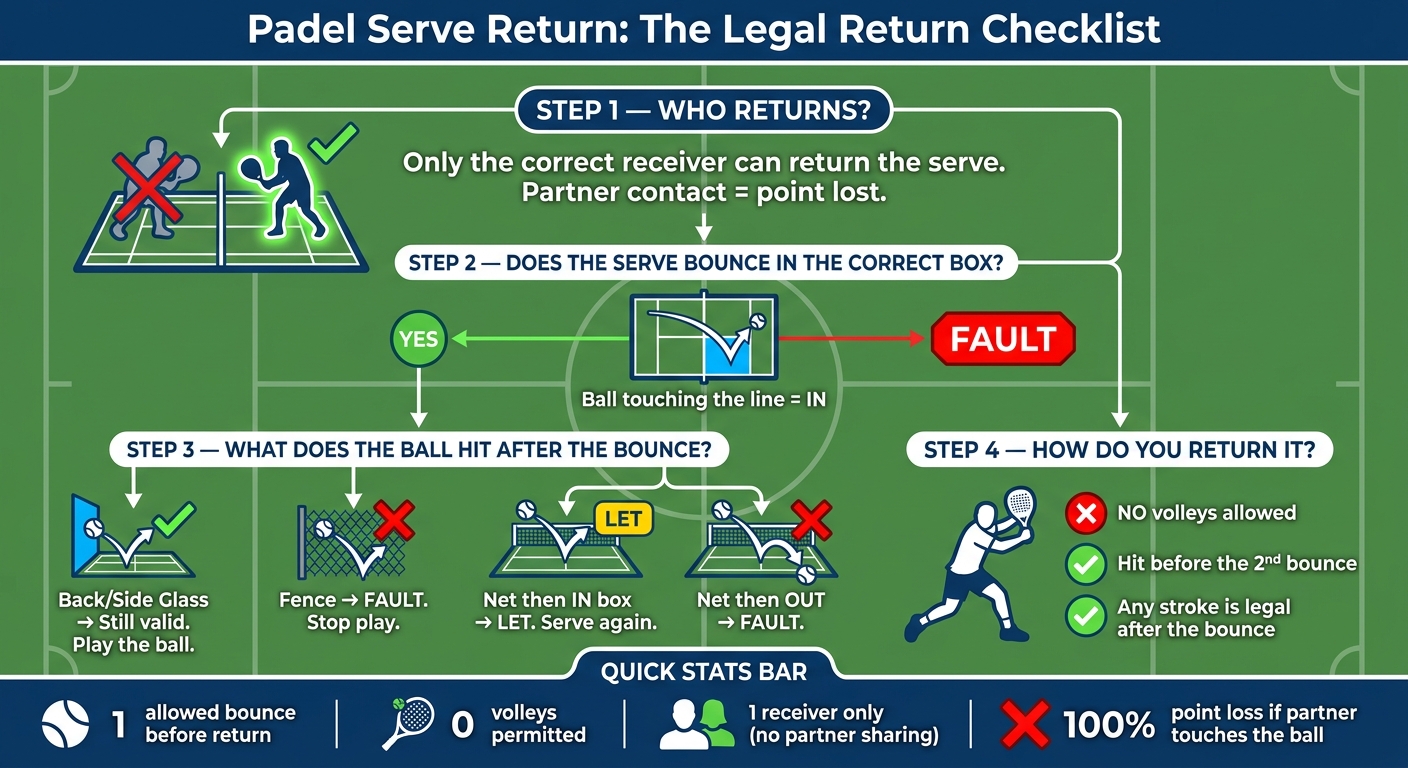
Padel Serve Return Rules: Step-by-Step Visual Guide
Receiver position and the first bounce
Which side each player receives from during a set
On the receiving team, each player chooses a side - right or left - and stays there for the whole set. In other words, your receiving side is fixed during that set. You can switch sides only when the next set starts.
That one choice affects your starting spot on every return game.
Where to stand before the serve arrives
The rules don't tell you exactly where to stand as the receiver. So the best spot is the one that gives you enough room to react to a wide serve and a deep bounce.
A lot of serves are hit wide to drag you off the court. Because of that, it often helps to stand a bit closer to the side glass. That can give you a better angle on the ball and more time to deal with the serve.
Your partner can stand anywhere on your half of the court.
Why the first bounce determines whether the return is legal
Once the serve makes a legal first bounce, you have to hit the ball before it bounces a second time.
If that first bounce sends the ball into the back glass, don't rush it. Let the ball come off the glass first, then play your shot.
So after the ball has bounced legally, the next decision is simple: do you take it after the bounce, or do you use the glass?
sbb-itb-5591e69
Bounce rules that affect whether you should play the ball
What makes a serve bounce valid versus a fault
A serve is good if it lands in the correct diagonal service box. And yes, the lines count. If any part of the ball touches the service box line, the serve is in [6].
After that first bounce, what the ball hits next matters. If the serve lands in the right box but then hits the fence, it’s a fault even though the bounce itself was good [2][5]. At that point, stop the play. It’s not a returnable ball.
When the ball hits the back glass after the bounce
Here’s where many players pause for a split second. If the serve bounces in the correct service box and then hits the back glass or side glass, the serve is still valid [1][2].
So if the bounce was legal, the ball stays live. You need to play your return before it bounces a second time.
Net contact and other let or fault situations
Net contact changes the call right away. If the serve hits the net and then lands in the service box, it’s a let, so the server takes that serve again [2][4]. If the ball clips the net and lands outside the box, that’s a fault [2][4].
Here’s the quick version:
| Situation After the Serve | Result |
|---|---|
| Lands in box, hits back or side glass | Valid [1][2] |
| Lands in box, hits fence | Fault [2][5] |
| Hits the net, lands in box | Let [2][4] |
| Clips net, lands outside box | Fault [2][4] |
| Bounces twice before you hit it | Point lost [1][3] |
How to hit a legal return back into play
Shots you can use after the serve bounces
Once the serve is legal, your job gets pretty simple: focus on timing and control. After the ball lands legally, you can use any stroke you want. The key is simple: hit the ball before it bounces a second time.
If the ball comes off the back glass or side glass after that legal bounce, you can play it off the glass. That extra rebound buys you more time, which can help a lot on wide serves when you need a bit more space to set up your swing.
Common illegal returns that lose the point
A serve return is illegal if you volley it. You also lose the point if the ball bounces twice before you hit it, or if your partner makes contact with the serve.
Return scenarios players face in real matches
Here are the return outcomes players run into most often during match play:
| Situation | Point Result |
|---|---|
| Ball bounces in box, hits back glass, receiver plays it | Point continues |
| Receiver takes it off the side glass after a legal bounce | Point continues |
| Receiver volleys the serve | Point to server |
| Ball bounces twice before receiver hits it | Point to server |
| Receiver's partner hits the serve | Point to server |
ESSENTIAL Return Rules: Avoid These MISTAKES & Elevate Your Game! | ThePadelSchool.com
Conclusion: Key rules to remember and where to practice
These four rules cover the legal return after serve: stay on your side, let the serve bounce once, avoid volleys, and play the ball before the second bounce.
4 rules every player should know
- Stay on the same side for the set. Switch only at the start of the next set.
- Let the serve bounce once in the correct service box before you hit it.
- Never volley the serve.
- Hit it before the second bounce.
One more detail matters in live play: glass is live; fence is a fault. You can return a legal serve after it comes off the back or side glass, but the point stops if the ball hits the fence.
The best way to lock these habits in is simple: get reps on court until the reaction feels automatic. To practice these returns, use Padel and Tennis Courts in the UK to find courts and coaching venues near you.
FAQs
Can I return a serve after it comes off the glass?
Yes. Once the ball lands in the correct service box, it’s in play. That means you can let it hit the back glass or side glass before you return it.
There’s one catch: you have to hit the ball before it bounces on the ground a second time.
If the ball hits the wire fence after that first bounce, it’s still a fault.
What happens if the serve hits the fence after bouncing in?
If a serve lands in the correct service box and then hits the wire mesh fence, it is a fault.
The fence is handled differently on the serve than it is during a normal rally. After the bounce on a serve, a ball that touches the fence is dead. If it hits the glass after a valid bounce, play can continue.
Can my partner take the return instead of me?
No. Only the designated receiver, positioned diagonally opposite the server, may return the serve. If your partner hits the serve, your team loses the point.
After the return, you and your partner can switch positions during the rally, but you must stay on your assigned receiving side for the entire set.