If you want the short answer: this is one of the oldest working tennis courts on Earth, and you can still watch matches there today. The court sits inside Hampton Court Palace, dates back to the Tudor period, opens daily from 6:30 a.m. to 11:30 p.m., and has 500+ members.
Here’s what I’d want to know before going:
- What it is: a live real tennis court, not modern lawn tennis
- Why people go: royal history, live matches, and a rare sport still being played
- Who it suits: players, palace visitors, and people who just want to watch
- How to visit: gallery access comes with palace admission
- How to play: book a beginner lesson through the club staff or book a court at other top UK locations
- What it costs: adult palace tickets start at $36.00 off-peak; listed local prices are £29.00 to £32.00
- How to get there: train from London Waterloo to Hampton Court, then about a 5-minute walk
- Best time to go: weekday afternoons after 1:00 p.m. for a quieter visit
A few points stand out fast. The court has been in use for nearly 500 years. The game uses wooden racquets, handmade balls, sloped roofs, wall openings, and the odd chase scoring rule. And while the place is historic, it’s not just for display - matches are still played almost every day.
If you’re planning a visit, I’d think of it this way: you’re getting part sports venue, part royal history site, and part palace add-on in one stop.
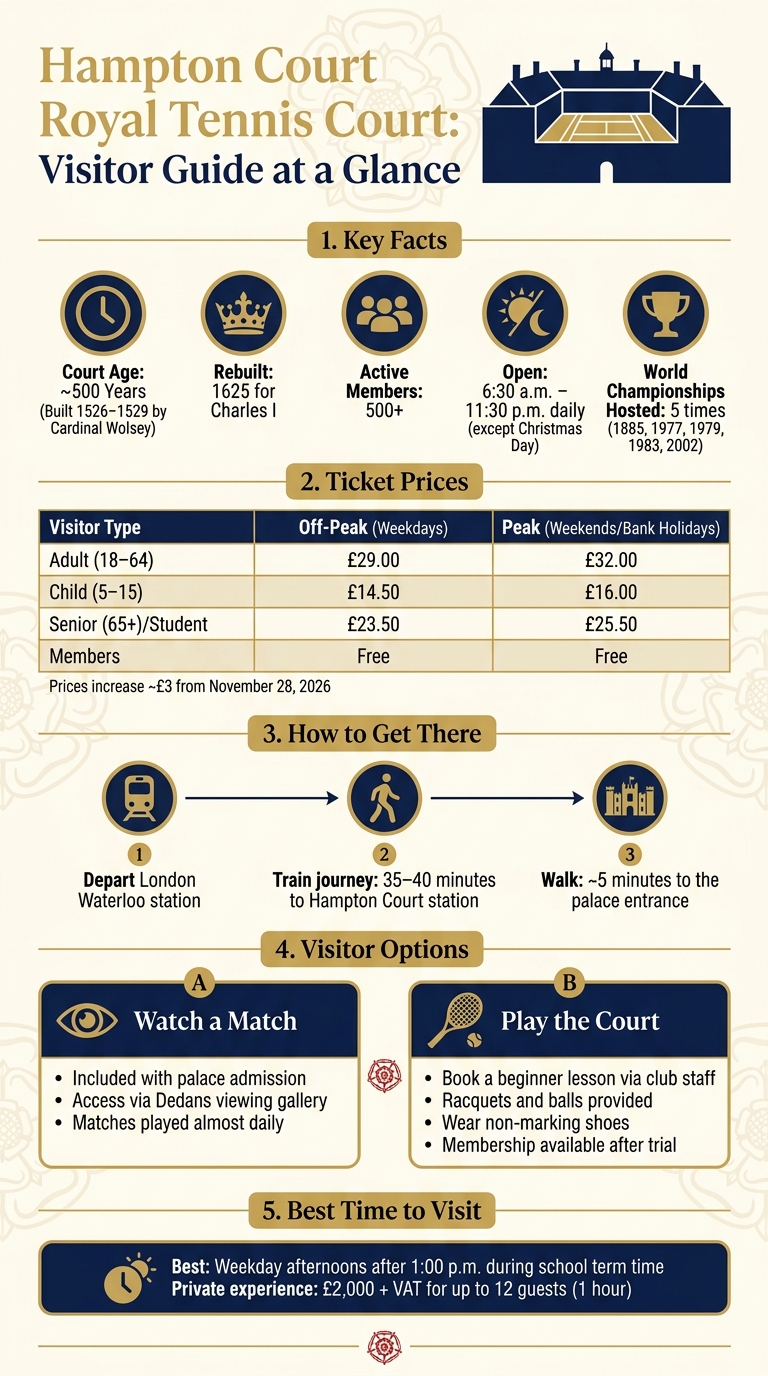
Hampton Court Royal Tennis Court: Visitor Guide at a Glance
We Played King Henry VIII's Favourite Sport at Hampton Court Palace
sbb-itb-5591e69
The Court's Royal History
The Royal Tennis Court at Hampton Court has been in use for nearly 500 years and still runs as a working court [9]. That long run is a big part of why its royal past still feels close and relevant to visitors.
From Wolsey and Henry VIII to the current court
The walls that remain today still tell the story of how the court changed through Tudor, Stuart, and later periods. Cardinal Wolsey commissioned the first court here between 1526 and 1529. Henry VIII started playing at the palace in 1528, and the game soon became a major part of Tudor court life, tied to exercise, rank, and gambling [1][2].
"It was the prettiest thing in the world to see him play; his fair skin glowing through a shirt of the finest texture." - Sebastian Giustiniani, Venetian Ambassador, describing Henry VIII in 1519 [1][2]
The current court was rebuilt for Charles I in 1625. Three of the four walls come from that rebuild, while the outer wall to the right of the viewing gallery is the surviving section of Wolsey's first court. Charles II later ordered more work in 1660, including a new tile floor and repairs to the roof [1][2][5].
Above the net, the interlaced initials belong to William III and Mary II, who reigned from 1689 to 1702 [5].
Original features and live matches today
This isn't just a historic space. It still hosts live matches almost every day. The court has staged the Real Tennis World Championship five times: 1885, 1977, 1979, 1983, and 2002 [5]. It also still holds major professional events. In 2024, it hosted the Champions Trophy from July 30 to August 4 [9]. And the Dedans viewing gallery still looks out over live play, much as it has for centuries [1][2].
How Royal Tennis Works
The court’s Tudor layout still shapes every point.
Court layout, racquets, and balls
The court’s odd shape drives every rule. This isn’t an old design kept around for show. It still decides how the game is played today. At Hampton Court, the court is about 1.5 times as long as a outdoor tennis courts in London and a little wider than a doubles court. It’s fully enclosed, with four walls, a floor marked with yard lines, and sloping wooden roofs called penthouses running along three sides. [3][10]
The court is split into two ends: the Service Side, where the server always plays from, and the Hazard Side, where the receiver stands. Three openings can end the point on the spot if the ball lands in them:
- The Dedans behind the server
- The Grille in the back corner of the hazard side
- The Winning Gallery on the hazard side wall
There’s also the tambour, one of the court’s strangest features. It’s a buttress that juts out from the hazard-side wall at an angle and can send the ball sharply across the court, often at almost 90 degrees. [3][10]
Real tennis racquets look different for a reason. They’re wooden, usually made from hickory or ash, and they’re heavier than modern lawn tennis racquets. The head is asymmetrical, with a large diagonal string area built for cutting the ball. The balls are handmade too, with a cork or webbing core, twine binding, and a wool cloth cover. [3][10]
Scoring, chases, and match formats
Those openings help set up the rule that gives the game its own character: chases.
Real tennis uses the familiar 15, 30, 40 scoring system, but there’s a twist: the previous-point winner is called first, not the server. A set goes to the first player to win six games, and there’s no need to win by two clear games. [3][10]
For most newcomers, the chase rule is the part that takes a minute to sink in. If a ball bounces twice without being returned, or goes into certain galleries, the marker calls a chase based on the yard line the ball crossed. The point does not end right there. Instead, it gets played off later after the players switch ends, and the other player has to hit a shot that lands closer to the back wall than the original chase mark to win it. Players change ends after two chases, or at game point if a chase is waiting to be played. Club matches use a handicap system, and the court also hosts singles, doubles, and championship-level matches. For those inspired to start playing, beginner training and local coaches can help you master the basics of the game. [3][10]
What watching a match feels like for first-timers
Once the chase system clicks, the match starts to make a lot more sense.
Balls can come off the penthouse roofs and the tambour, which creates angles you just don’t see in modern lawn tennis. The net is 3 feet high in the center and 5 feet at the ends. [3]
If it’s your first match, keep your eyes on the floor lines so you can track the chases, and listen for the marker calling the score. For first-timers, the Dedans gives the clearest view. [3][10]
How to Play or Visit the Royal Tennis Court
Now that the layout and scoring make more sense, here's the practical part: how to see the Royal Tennis Court for yourself, or actually get on it.
Playing the court: club access, beginner sessions, and booking
The Royal Tennis Court is a private members' club. That said, first-timers aren't shut out. Newcomers can book an introductory lesson by contacting Head Professional Nick Wood or one of his assistants.[2]
You don't need to show up with your own kit. The club provides racquets and balls, which makes things a lot easier for beginners. Just wear non-marking shoes. If you like the session and want more, you can apply for membership afterward.[1]
If playing isn't on your plan, the viewing gallery is the next best thing.
Seeing the court on a palace visit
Non-players can watch from the Dedans viewing gallery with standard palace admission. And because the court is in use daily except Christmas Day, there's a good chance you'll catch live play instead of staring at an empty court.[1][2]
To get there, enter through the East Front Gardens and head to the court in the Great Fountain Garden area. One thing to watch for: that route can close for private events or maintenance, so it's smart to check the official palace website before you go.[1][11]
Tickets, opening times, and getting there from London
Standard admission includes access to the gallery. If you want to play, you'll need to book that separately.
| Ticket Type | Off-Peak (Weekdays) | Peak (Weekends/Bank Holidays) |
|---|---|---|
| Adult (18–64) | £29.00 | £32.00 |
| Child (5–15) | £14.50 | £16.00 |
| Senior (65+) / Student | £23.50 | £25.50 |
| Members | Free | Free |
Prices are valid until November 27, 2026; they increase by about £3 starting November 28, 2026. [6]
If you're after a more private visit, the one-hour Real Tennis Experience costs £2,000 plus VAT for up to 12 guests.[8]
Getting there from London is pretty simple. Take the train from London Waterloo to Hampton Court station. The journey usually takes 35–40 minutes, and the palace is about a 5-minute walk from the station. Booking online is the safest move if you want guaranteed entry and, in most cases, the lowest price.[4][6]
What to Know Before You Go
Dress, etiquette, and comfort on site
Now for the practical part. If you're playing, wear light sportswear. If you're watching, keep noise to a minimum and don't distract the players. [1][2]
The court itself is indoors, so rain or cold won't get in the way there. But a full Hampton Court Palace visit is a different story. You'll likely cover parts of the palace grounds and gardens, which stretch across about 60 acres, so comfortable walking shoes make a lot of sense. Historic Royal Palaces says you should allow at least three hours to see the palace rooms and gardens properly. Lockers are available in the Buggy Store in Clock Court, and accessible toilets can be found in the Wilderness, Base Court, Fountain Court, and Kitchen Garden areas. [4][7]
Best times to visit and planning a broader racquet-sport trip by discovering local clubs
If you want to see live play, timing matters. For a calmer visit, go on an off-peak weekday after 1:00 p.m., especially during school term time. It's also smart to check the Historic Royal Palaces website before you leave, since temporary route closures can affect your plans. [2][7][11]
Key points to remember
A few details are worth keeping in mind:
- Hampton Court's royal tennis court goes back to Henry VIII and is still used by an active club with more than 500 members. [1][2]
- Access to the viewing gallery is included with standard palace admission.
- If you want to play, you'll need to contact the club's professionals and set up a lesson. [1][2]
- Check current ticket prices and opening times before your visit, since rates increase on November 28, 2026. [6]
FAQs
Can beginners try real tennis here?
Yes. Beginners are welcome, and the professional team can set up intro sessions and lessons.
There’s also a dedicated Real Tennis Experience, where guests spend an hour getting to know the game’s history and how it works. Real tennis has a lot going on, but the session is designed to make it approachable for players of all ages and skill levels.
Do I need a palace ticket to watch a match?
Yes. You need a ticket to enter the palace grounds to watch a match, and access to the viewing gallery at the Royal Tennis Court is included with general palace admission.
If you’re a Historic Royal Palaces member, entry is free.
How is real tennis different from modern tennis?
Real tennis is the original indoor racquet sport that came before modern lawn tennis. It uses a similar scoring system, but the game happens on an indoor court that’s uneven by design, with four walls, a sloping roof, and built-in targets like galleries, bells, and windows.
Players use handmade balls that don’t bounce much, along with smaller, heavier racquets. That changes the feel of the game right away. It also has tactical rules like chases, so winning isn’t just about hitting hard. You need to read the court, use its odd angles, and play with intent.